
  • Navigating our Journey Together on Sustainability Reporting and Assurance

    ICAEW Sustainability Event
    London, UK English

    IAASB Chair Tom Seidenstein delivered the following keynote address during the ICAEW event New International Sustainability Assurance Standards, held at Chartered Accountants' Hall in London.

    Good morning. I am honored to return to the Institute of Chartered of Accountants of England and Wales (ICAEW). I wanted to thank Malcolm Bacchus for the kind introduction and the entire ICAEW team for hosting this timely event and their continued support of global standards.

    The ICAEW building has a special place in my heart. It was in this building, more than two decades ago, that I leapt deep into the world of standard setting. In my role with what would ultimately become the IFRS Foundation, we interviewed many of the candidates that became the original members of the International Accounting Standards Board (IASB).

    It must have been something in the water that day. Maybe you in the audience and others impacted by the work of the International Auditing and Assurance Standards Board (IAASB) regret the choice of water then. However, at that moment of time in the autumn of 2000, I got the “bug” for standard setting. Twenty-four years later, I stand before you, nearly six years in my tenure as IAASB chair. In all seriousness, I can tell you that we at the IAASB are truly appreciative of the mandate that we have and the support that the ICAEW and accountants throughout the world have given us. We will continue to do our best to drive confidence in the work of accountants throughout the world.

    Events such as the one being held today are essential to build knowledge, to exchange ideas and experience, and to guide standard setters, regulators, and practitioners as we embark on the sustainability journey together.

    Journeys are never simple. On a journey, you often meet the unexpected. You meet delays from time-to-time. You often must make compromises along the way. The most important thing ultimately is keep advancing towards the destination.

    For the last several years, we have witnessed an accelerating, almost inevitable momentum on our journey—towards a new era of external reporting that would mandate both financial and non-financial information to describe corporate performance. Not surprisingly, policymakers, regulators, standard setters, and a broad range of market participants called for a range of sustainability requirements that would form the basis of a new reporting ecosystem.

    Let’s take two of the world’s largest capital markets. The European Union approved the Corporate Sustainability Reporting Directive, or CSRD, and with it came European Sustainability Reporting Standards. The US Securities and Exchange Commission approved a Climate Disclosure Rule.

    Indeed, much like the world of financial reporting and audit, we also saw a trend towards adopting global baselines. The IFRS Foundation established the International Sustainability Standards Board with significant support from securities regulators globally. And jurisdictions throughout the world, including here in the UK and others such as Australia, Brazil, Japan, Nigeria, Singapore, and Turkey, initiated processes for considering or mandating reporting and sustainability assurance regimes.

    In recent weeks, several jurisdictions have announced a reconsideration or recalibration of their sustainability requirements and commitments. My message today is that we must pay attention to this shifting landscape and understand the underlying rationale for changes. As an independent standard-setter, we cannot operate in a vacuum and must be responsive to shifting public interest demands.

    However, I remain convinced that the longer-term trend is likely to remain directionally the same. Investors globally, those who provide capital, will continue to seek broader measures of corporate performance. Even before mandatory requirements more than 95 percent of the world’s largest companies were providing some form of sustainability reporting. And despite the shifts in some jurisdictions, many companies are continuing to adopt sustainability reporting requirements to meet investor demands.

    It is therefore my first point and maybe most important point today—we need to keep our eye on the long-term destination for reporting sustainability-related information. We need to remain ambitious but also accept that the journey will vary by jurisdiction and will need to adapt to learnings. In doing so, we should commit to creating a system for sustainability and other material non-financial measures that focuses on building trust and confidence in the information companies provide, much as we have in the world of financial reporting.

    We can take a few lessons from the world of financial reporting in terms of constructing a trusted sustainability reporting ecosystem. The most important is that trusted reporting should be built on a foundation of:

    • High-quality reporting standards
    • Complemented by robust assurance standards
    • Supported by ethical and independent requirements
    • Overseen by empowered regulatory authorities

    In my mind, the public interest requires those components to:

    • Enable global comparability
    • Encourage the development of a cadre of professionals capable of producing and assuring high quality reporting
    • Be unapologetic in its commitment to quality, rigor, and ethics

    Indeed, that long-term vision was our motivation at the IAASB when we completed International Standard on Sustainability Assurance (ISSA) 5000. ISSA 5000 a global baseline that can work in every jurisdiction—whether you are in Europe, Asia, the Americas, Africa or Australia. In doing so, we moved quickly, because the International Organization of Securities Commissions (IOSCO) urged us, along with our colleagues at the International Ethics Standards Board for Accountants (IESBA), to meet the deadline of December 2024 to complement the ISSB’s work. We were also conscious of European and other national timelines and requirements.

    ISSA 5000 did not sacrifice quality for speed. We followed a rigorous due process and conducted unprecedented outreach before finalizing the standard. We involved thousands of stakeholders on six continents, including our eight roundtables spread throughout six continents, bilateral meetings, and our exposure draft and comment process.

    In developing ISSA 5000, the IAASB was conscious that sustainability assurance was already taking place around the world. For this reason, we adopted a no “greenfielding” strategy—we built off existing practices already embedded in our well-established and widely used assurance standards, ISAE 3000 and 3410. We needed to provide more specificity to reflect convergence around new sustainability reporting requirements and ensure greater consistency in practice. We also were able to draw upon recent modernization of audit standards, where appropriate. Finally, we benefitted from the advice of the thousands who participated in our consultations. With the benefit of their advice, we reflected themes we heard throughout the comment process. My colleague, Josephine Jackson, will shortly describe specific elements of the standard in more detail.

    We believed it was important to develop the standard so that a diversity of practitioners could use ISSA 5000 for a wide range of sustainability assurance engagements. We committed to ensuring that the standard is useable and does not create any unnecessary burdens. We therefore paid particular attention to scalability and proportionality throughout.

    My second major message is that for the IAASB, the journey on sustainability doesn’t end with the approval of the standard. We stand ready to help support the consistent application of standard in several ways.

    First, we will support the adoption and implementation with significant energy and resources. We will continue to publish a wide range of implementation support. On January 27, jointly with IESBA, we released a first package of guidance and support videos—with more to follow. We have also committed to a wide range of outreach activities, which have already begun. Our focus is on issuing guidance that is concise, focused and pragmatic.

    Second, we will give the market time to absorb ISSA 5000. We need a period of stability. Therefore, the emphasis will not be on the setting of new standards in the 5000-space. Do not expect a new 5000 series standard soon.

    Third, we will set up a wide range of monitoring activities to determine whether there are practical implementation issues. We will work closely with our advisory council, national standard-setters, and regulators to get this feedback. We are in the process establishing a technical implementation contact group as well. Even though we will not write a new 5000 series standard in the next few years, we as a Board, stand ready to respond to market feedback if adjustments or guidance to ISSA 5000 are necessary.

    My third major message is that if we are to reach our ambitious destination, we will require support and collaboration from a wide range of parties. We are calling upon policymakers and practitioners to adopt ISSA 5000 when adopting sustainability requirements. The UK Financial Reporting Council’s study will hopefully pave the way for broad use of ISSA 5000 among UK practitioners. The IAASB will not attempt to dictate the timing and phasing of requirements throughout the world, but a commitment to assurance requirements that complement reporting requirements is critical if reported sustainability information is to engender the same confidential as financial reporting.

    We also call on the accountancy profession to prepare for broader scale demand for sustainability assurance engagements. This means organizations, like the ICAEW, play a critical role in developing curriculum and training programs. Accountancy and other assurance firms will need to develop expertise and capacity with the emerging requirements. And a new generation of talent in accountancy profession will have to expand skillset in the audit and assurance toolkit. Clearly, this will be a challenge, but we must see this as an opportunity for the profession to demonstrate their continued relevance and remain attractive to future generations of professionals.

    Let me close by returning to a theme that I highlighted earlier. Our sustainability journey will not always be smooth or go as anticipated. We need to work together with a sense of ambition and patience.

    We must always remember our ambitious goal—to create a system of sustainability reporting that engenders the same level of trust as financial reporting. That will not be easy or immediately achievable—but that should not deter us. Companies will need to develop systems of internal controls, governance, and data gathering to improve reporting. We will need to train assurance specialists and reporting teams. Investors and other users will need to learn how to best analyze the new information, if unfamiliar with sustainability reporting. And regulators and standard setters must be ready to react as challenges arise.

    We also need patience because the initial waves of reporting will not be perfect. But imperfection should not deter us from the journey ahead. As we move forward, the IAASB will continue to engage with stakeholders across sectors, listen to market feedback, and provide the support needed for successful implementation.

    Thank you once again for your trust, your collaboration, and your commitment to a future where transparency and integrity in reporting serve the public interest. We look forward to continuing this journey together, building a robust foundation for sustainable economies.

    Keynote address by IAASB Chair Tom Seidenstein
  • IAASB Contributes to New Book on Business and Sustainable Development

    English

    The IAASB is pleased to contribute to the new book, For the World’s Profit: How Business Can Support Sustainable Development, published by The Brookings Institute. IAASB Chair Tom Seidenstein and Former Board Member Warren Maroun co-authored a chapter on the rollout of International Standard on Sustainability Assurance (ISSA) 5000 and the evolving assurance ecosystem.

    This volume explores key debates shaping the future of business and sustainability, including value creation, risk management, and corporate accountability. The IAASB’s contribution highlights the importance of high-quality assurance for sustainability reporting and the global adoption of ISSA 5000, ensuring transparency, credibility, and trust in sustainability-related information.

    For more information, visit The Brookings Institute website.

  • Development of ISSA 5000 and future activities of the IAASB

    Japanese Institute of Certified Public Accountants English

    From January 21 to 24, 2025, Tom Seidenstein, IAASB Chair and Josephine Jackson, IAASB Vice-Chair visited Japan. Tetsuya Mogi, JICPA Chairman and President and Takako Fujimoto, JICPA Deputy President interviewed with Mr. Seidenstein and Ms. Jackson.

    Mr. Mogi, JICPA Chairman and President: Firstly, I would like to talk about International Standard on Sustainability Assurance 5000 "General Requirements for Sustainability Assurance Engagements" (ISSA 5000), which was published in November 2024. We believe the publication of ISSA 5000 is a great milestone for the IAASB as well as for stakeholders across the globe. Tom, could you please briefly introduce the key features of ISSA 5000?

    Continue reading the article on the JICPA website in English or Japanese.

    Interview with IAASB Chair Tom Seidenstein and Vice-Chair Josephine Jackson

  • The IAASB in 2025: A Look Ahead

    English

    On behalf of the IAASB, Happy New Year to all. The IAASB closed out a productive 2024 by approving ISA 570 (Revised), Going Concern closely following the September 2024 approval of ISSA 5000, General Requirements for Sustainability Assurance Engagements. It is natural for our stakeholders to want to know what the IAASB plans to do in 2025. Our strategy document, Elevating Trust in Audit and Assurance, provides clear guidance.

    For 2025, from a standard-setting standpoint, we are translating the strategy into three leading tasks:

    1. Finish what we have started.
    2. Give the market time and support to ensure high-quality implementation.
    3. Increase our focus on technology to enhance audit and assurance quality.

    Finish what we have started. By the end of the first half of 2025, the IAASB will complete its projects on Fraud and the second phase of our IESBA convergence work on Listed and Public Interest Entities. The IAASB intends to approve revisions to the Fraud standard in March and will undertake a consultation and outreach on Listed and Public Entities in Q1 to permit June 2025 approval. With the finalization of these projects, an important phase of our 2024-2027 work plan ends.

    Give the market time and support to ensure high-quality implementation. In recent years, IAASB major initiatives included ISA 315 (Revised 2019), the quality management suite of standards (ISQMs 1 and 2, and ISA 220 (Revised), group audits (ISA 600 (Revised), the ISA for Audits of Financial Statements of Less Complex Entities, ISSA 5000, and going concern (ISA 570 (Revised 2024). With the addition of the standards we anticipate finalizing in the first half of 2025, our focus will turn to supporting implementation of these standards, allowing time for their effective adoption, and beginning to assess their effectiveness through post-implementation reviews. For example, jointly with IESBA, we will be launching comprehensive implementation support plans for our sustainability standards at the end of January.

    Increase our focus on technology to enhance audit and assurance quality. As our work plan transitions, there will necessarily be a period of calm in terms of new standards coming into effect.  However, we will not slow our work on key public interest topics. In September, the IAASB approved a new Technology Position and “committed to actively facilitating and, where appropriate, encouraging the appropriate use of technology.” While technology is not the sole driver, a dedicated focus on technology will be a priority over the next three years. Our recent project proposal to revise our Audit Evidence and Risk Response standards, scheduled to be completed in early 2027, highlights this commitment. We will be updating our project timelines shortly to reflect the technology priority.

    The IAASB has emphasized the value of stakeholder engagement and has deepened outreach over recent years. As we pursue the three actions above, expect this level of outreach to continue.

    Tom Seidenstein, IAASB Chair

  • IAASB Chair Included in Accounting Today's Top 100 Most Influential People in Accounting, 2024

    New York English

    IAASB Chair Tom Seidenstein has been included in the Accounting Today listing of Top 100 Most Influential People in Accounting. 

    Accounting Today: “The future of accounting will definitely be more global, and as head of the International Auditing and Assurance Standards Board, few people have more influence over the future of audit and attest worldwide than Seidenstein, who’s also working to make his standard-setting more agile, more collaborative, and more relevant, while also pioneering areas involving sustainability and technology.”

    Read the full listing on the Accounting Today website here.

  • Strengthening the Foundations of Sustainability Reporting: ISSA 5000 and Assurance, Core Elements of Building Trust

    Webinar: Shaping the Future of Sustainability Assurance Engagements
    English

    IAASB Chair Tom Seidenstein delivered the following keynote address during the Accountancy Europe/IFAC webinar, “Shaping the Future of Sustainability Assurance Engagements.” Learn more about the event and access materials from presenters on the IFAC website here.

    Good afternoon. I am so pleased to be here today for this timely webinar. I want to express my appreciation to Accountancy Europe and IFAC for hosting this event and for their continued support for global standards, set by an independent standard-setting body committed to a robust due process. And I also want to thank you, the over 1,200 registered participants, who have given up your time to join today.

    Today’s webinar is titled, “Shaping the Future of Sustainability Assurance Engagements.” Indeed, my remarks will shortly turn to ISSA 5000, the standard that the International Audit and Assurance Standard Board (the IAASB) approved in September. In fact, I bring good news—this morning, the Public Interest Oversight Board (PIOB), certified the standard for final publication. It is now officially ready to use in Europe and elsewhere.

    While ISSA 5000 certification is a big deal for the IAASB, we know that we are part of something bigger. We are at the advent of a new era of external reporting. Users will expect a broader range of information—financial and non-financial information—to assess corporate performance.

    Today, policymakers, regulators, standard-setters, and a broad range of market participants together are creating the foundations of a new reporting ecosystem. Well-calibrated actions should help build a system that engenders trust, confidence, and well-functioning economies. In doing so, we can encourage a new generation of professionals to choose careers in reporting. We together can do our part to build more resilient, sustainable, and efficient economies.

    We can take a few lessons from the world of financial reporting in terms of constructing this new sustainability reporting ecosystem. The most important is that a trusted reporting should be built on a foundation of:

    • High-quality reporting standards,
    • Complemented by robust assurance standards,
    • Supported by ethical and independent requirements, and
    • Overseen by empowered regulatory authorities.

    In my mind, the public interest requires those components to:

    • Enable global comparability,
    • Encourage the development of a cadre of professionals capable of producing and assuring high quality reporting, and
    • Be unapologetic in its commitment to quality, rigor, and ethics.

    These are points that EU policymakers know well. These components are embedded in the Corporate Sustainability Reporting Directive (CSRD). When the IAASB initiated the work on ISSA 5000 two short years ago, we committed ourselves to supporting the EU’s leadership.

    Make no mistake, the IAASB has created a global baseline that can work in every jurisdiction, in Europe and elsewhere. At the same time, we were particularly conscious of European timelines and requirements under CSRD. It was obvious to the IAASB that we can’t have a globally accepted standard without the European Union, considering its leadership position.

    EU deadlines and IOSCO recommendations therefore served as a helpful prompt to complete our work in September of this year, three months faster than originally scheduled. We wanted to give practitioners as much time to prepare.

    Timeliness, however, did not come at the expense of our due process and extensive engagement. We involved thousands of stakeholders in six continents through events like this one, our eight roundtables, bilateral meetings, and our exposure draft and comment process. Throughout the consultation and drafting periods, we worked closely with the European Commission, European securities regulators, the Committee of European Auditing Oversight Boards, and EU stakeholders in all sectors. Accountancy Europe deserves special thanks for helping to convene so many helpful discussions.

    Willie Botha, the IAASB’s Technical Director, will describe the standard in more detail shortly. I did want to highlight a few elements that either were vital to European requirements or reflects themes we heard in Europe throughout the comment process.

    • ISSA 5000 addressed both limited and reasonable assurance engagements. Before finalizing the requirements, we ensured differences in work effort for limited and reasonable assurance were clearer.
    • We created an assurance framework that works with both traditional materiality and double materiality concepts and have included enhanced explanatory material to support practitioners.
    • We highlighted the work required related to an entity’s materiality process.

    In developing ISSA 5000, we were mindful of the practical challenges of implementation. For this reason, we adopted a no “greenfielding” strategy—we built off existing practices already embedded in our well-established and widely used assurance standards, ISAE 3000 and ISAE 3410. We also paid particular attention to scalability and proportionality throughout. This was because we know that there will be a diversity of practitioners for a wide range of engagements, and because we committed to ensuring that the standard is useable and does not create any unnecessary burdens.

    Finally, we at the IAASB are committed to support implementation through the issuance of timely guidance. We will release a package of guidance, support videos, and wide range of outreach activities beginning in January 2025. Our focus will be issuing guidance that is concise, focused and pragmatic. We will also certainly depend on partnerships with bodies such as IFAC and Accountancy Europe to amplify these efforts.

    So what is next? The hard work did not end with the standard’s approval. At the IAASB, we will support the adoption and implementation with significant energy and resources. As I just mentioned, we will provide a wide range of implementation support. We are also conscious that we need to give the market time to absorb ISSA 5000. We need a period of stability. Therefore, the emphasis will not be on the setting of new standards in the 5000-space. However, we as a Board stand ready to respond to market feedback if adjustments or guidance are necessary. We will be working closely with our advisory council, national standard-setters, and regulators to get this feedback.

    We now call upon policymakers and practitioners to adopt ISSA 5000. We are pleased that the European Commission has asked the CEAOB to advise the Commission on how to incorporate ISSA 5000 into CSRD-related requirements. This commitment to a global baseline has and will serve as a catalyst for other jurisdictions to use ISSA 5000 as well.

    Earlier, I said that ISSA 5000 addressed many of the elements in CSRD. At the same time, as a global standard, ISSA 5000 does not incorporate the specific requirements unique to Europe, such as the green and digital taxonomies. As the term global baseline implies, we anticipate jurisdictions to add on requirements to meet their regulatory mandates. Our expectation, as the European Commission’s letter to the CEAOB notes, is that “carve outs” should be avoided when they impact the performance of the engagement. We know that the reasonable assurance requirements in ISSA 5000 will not be part of the first-wave requirements for the European Union. That was anticipated in Europe and elsewhere. That is why we distinguished the limited and reasonable assurance requirements clearly.

    Let me close by emphasizing the importance of collaboration and cooperation in the journey to develop ISSA 5000. The standard is a testament to the dedicated support and partnership we’ve received, including from organizations like Accountancy Europe, IFAC, and many that have contributed their expertise, insights, and feedback.

    As we move forward, the IAASB will continue to engage with stakeholders across sectors, listen to market feedback, and provide the support needed for successful implementation.

    Thank you once again for your trust, your collaboration, and your commitment to a future where transparency and integrity in reporting serve the public interest. We look forward to continuing this journey together, building a robust foundation for sustainable economies.

    Keynote address by IAASB Chair Tom Seidenstein

  • Speech - APESB Dinner Event Novotel Melbourne. Keynote Address from Gabriela Figueiredo Dias, IESBA Chair

    English

    Good evening, esteemed guests and colleagues.

    It is an immense pleasure to stand before you today at this distinguished gathering.

    I would like to extend my deepest gratitude to the Accounting Professional & Ethical Standards Board and to Chair Nancy Milne very specially, for this very kind invitation to address you all. And I have had the privilege of counting on the unwavering commitment and dedication of my fellow IESBA Board member and dear friend Channa Wijesinghe, APESB CEO. I want to publicly recognize his highly valued contribution to the IESBA projects and strategy, thanking Nancy and the APESB Board and staff for all the support provided to Channa and to the IESBA.

    As some of you may know, I come from Portugal, a relatively small European country on our globe but one with a rich heritage of exploration and discovery. Ferdinand Magellan, the first person to sail the Pacific and around the world, proving that the earth is round. Vasco da Gama, the first European to sail from Europe to India, enabling trade with the Far East, or Bartolomeu Dias, the first European to sail around the Cape of Good Hope, opening a sea route from Europe to Asia.

    Well, I hear you say I’m in illustrious company, but I admit my wanderings have been far more modest in breaking new ground and changing the course of history. Before embarking on this new adventure with the IESBA in January 2022, I chaired the Portuguese Securities Commission (CMVM) for 5 years, and in total worked there for 13 years in different areas and roles. I was also a member of the Board of Supervisors of the European Securities and Markets Authority (ESMA), a member of the IOSCO Board, and vice-chair of the OECD Corporate Governance Committee.

    Yet, while I have not found new lands or established new trade routes, I have seen clearly the spirit of my seafaring forebears who were driven by a passion and ambition to bring worlds together, to bridge divides, to mark land for fellow citizens in order to open their minds to the wonders of new frontiers, new knowledge, new possibilities, and yes, a better world. Like my illustrious mariner countrymen of centuries past, I strongly believe timidity has no place if we are to set sail in that spirit and towards that vision of a new world. To borrow from Magellan’s words, “The sea is dangerous and its storms terrible, but these obstacles have never been sufficient reason to remain ashore… unlike the mediocre, intrepid spirits seek victory over those things that seem impossible.”

    It is with this ambition in mind that I made my way to the place where that conviction better translates into purpose, action, and impact – and that place is the IESBA.  

    An Interconnected but Ethically Afflicted World

    From the very different vantage points my wanderings have taken me, I have come to understand well the critical role played by markets and their agents in contributing, in a decisive way, to robust, resilient and dynamic economies, serving families, citizens, and ultimately, the society. From that intense experience, I have retained indelible conclusions:

    • That market integrity, and the integrity of the work and actions of all its agents, is a vital condition for sustainable economic systems; and
    • That in a deeply interconnected world, from technological, communications, economic and geopolitical perspectives, any isolated and fragmented frameworks and solutions will fail their objective of achieving strong and resilient responses to the different problems we need to address.

    Unfortunately, from these vantage points, I have also seen too many high-profile adverse events in the financial sector, too many collapses, and too many cases of unethical behavior in accounting firms, both in my country and internationally. These events have had painful consequences in terms of individual investors sometimes losing all their lifetime savings, employees losing their jobs, and institutional investors losing confidence and departing markets which desperately needed their capital, causing direct harm to citizens and leaving governments with huge financial stability problems.

    While all these events were different in many senses, there are two common and decisive factors I wish to highlight.

    First, in one way or another, these events unveiled widespread and persistent unethical conduct or practices, revealing corporate culture failures in companies, accounting firms and other organizations.

    And secondly, the events showed the ineffectiveness of individual reactions to individual cases, pointing to the imperative of integrated, though nimble, preventive responses.

    The consequences of unethical behavior in business and financial markets, and by agents who are entrusted the mission to provide confidence in business and organizations, reverberate in waves – sometimes towering waves – throughout the system and society.

    We must therefore recognize ethics as a structural and systemic element of financial resilience and economic performance, and agree on the need to expand the frontiers of possibilities for a more consistent, systematic and integrated approach to that objective.

    The Response Requires Unity of Purpose and Action

    This brings me to the question of how we might rescue businesses, companies and firms from its ethical afflictions.

    All market relations are built upon information and trust. Market integrity is the result of the integrated ethics of all its agents and parts. All market agents have large responsibilities in ensuring that the information that supports market decisions and economic relations is trustworthy, and all actors are responsible for ensuring that they contribute to the integrity and reliability of the system that supports the whole functioning of economies and the society itself.

    Professional accountants and accounting services are a crucial and very sensitive part of this system. Accountants’ social license to operate stems from the public expectation that they provide trust to the information and decisions of businesses, companies and clients.

    Therefore, I would like to stress the power of a strategic alliance among all stakeholders, among us all, among the accountancy profession, regulators, governments, international organizations, investors, companies, the corporate governance community and others. We must have the boldness of vision and the intrepidity to venture beyond our comfortable and familiar shores to contribute in each of our roles and through leveraging the power of togetherness to uphold ethics and trust in accounting services, in the profession and in business.

    Ethics must be the next frontier for us, because from the ethical afflictions we continue to witness in the business and financial world we live in, we know we must keep on making the journey towards a better place. And to chart this next frontier, we must have unity of vision, purpose and action, and importantly, trust in one another.

    Navigating the World of Risks with an Ethical Compass

    But how then do we navigate our journey forward together through this turbulent and uncertain world?

    If I were to choose three words to define the times we are living in, they would be: change, promise and risk.

    Change, and therefore promise and risk, is a condition for growth, progress and success in meeting the needs of an evolutive society.

    Important triggers for change – and risks – in our space are challenging the accountancy environment and calling all stakeholders, including the IESBA, to respond firmly to these risks, serving the public interest and the economic development for the welfare of the people.

    Ethics is an element of organizations’ risk profile, which may not be as front and center as legal conflicts, cyber risks or compliance risks, yet somehow runs through everything. In a world brimming with risks – from geopolitical tensions and societal shifts to environmental challenges – our ethical compass becomes not just a guide but a strategic imperative. As we confront these uncertainties, actions must reflect the integrity that defines an activity, a profession, an organization.

    Given the potentially significant impacts of unethical culture and behaviors in organizations, including accounting firms, ethics must lie at the heart of organizational strategy and risk management. It prevents unforeseen consequences, fosters a strong culture and builds trust. At a time when younger generations seek purpose and impact in their work, ethical conduct becomes a beacon that attracts and retains talent – a promise they can hold on to build a better world – whereas pervasive ethical issues make them stay away or depart from certain organizations or professions. Organizational and professional reputation is built on trust, and just like a sturdy ship with fresh sails navigating the high seas, strong ethical foundations can help organizations to weather crises and uncertainty.

    Organizations with a strong ethical culture and which choose to have ethics as a strategic asset for their growth and sustainability adapt better to rapidly evolving circumstances. Their agility stems from a foundation of integrity. They have built trust with their stakeholders and society. They have cultivated a culture of accountability and transparency. They have aligned their purpose and strategy with the public interest and the sustainable development goals. These are the qualities that make ethical organizations resilient and successful in the long run. And these are the qualities that IESBA strives to promote and support through our standards and guidance.

    That is why IESBA's ethics and independence standards are more relevant than ever in this world of risk – where we witness continuing concerns about fraud, corruption, tax avoidance, disruptive technological developments, and pressing sustainability reporting requests and issues.

    The awareness of emerging external risks, changes and challenges; the timely and humble identification of areas where we, as standard-setters, or the profession may have to adopt a different approach; and the efforts of us all to raise recognition of IESBA’s role in a coordinated way and to focus on the local implementation of our global standards are fundamental to the achievement of our common goals.

    The Role of IESBA and Its Standards

    IESBA is of course not a newcomer in sailing these choppy waters. Despite the dimension of the challenges, IESBA has over the past two decades strived to live up to its responsibilities as an independent global ethics standard setter in this ambitious project to bring ethics higher in the agenda in a world of change and risks. Let me outline a few of the ways in which we have recently brought the old world to join with the new, viewed through our ethical spyglass.

    Technology, one of the main triggers for innovation, with both severe impacts and great opportunities for the profession, is one of the fields where we have recently done important work. We undertook two comprehensive research phases into key technologies such as AI, blockchain, robotic process automation and cloud computing, culminating two reports issued in December 2019 and November 2022. These led, firstly, to a comprehensive revision of the IESBA’s International Code of Ethics to respond to the transformative effects of major trends and developments in technology on the assurance, accounting and finance functions (these revisions in fact come into effect this December); and secondly, to the publication of a series of thought-leadership pieces and guidance materials, in collaboration with some national standard setters and professional accountancy organizations, on topics such as ethical leadership in an era of complexity and digital change, and AI. These standards and resources have never been more timely and relevant as the world witnesses explosive growth in generative AI applications.

    Another area where we are bringing a new dimension of awareness and ethical responsibility is tax planning. In this regard, we just released last month the first global ethics standards on Tax Planning. Three years ago when this work started, there were many doubts and concerns about where this voyage would take us. Fear of the unknown was certainly in the air. Today, the ship has sailed and it is more than ever clear that ethics in tax planning is absolutely crucial to avoid pervasive cases of unethical tax planning and its very harmful impacts. In this regard, we have seen a metamorphosis in public attitudes to tax avoidance across jurisdictions. Tax planning is a subject with a high reputational risk for professional accountants, dramatically affecting the public trust in them.

    A third area where we have been sailing on a voyage for over 18 months now is Sustainability. In December 2022, we launched our two projects, one with the mandate to develop ethics and independence standards for sustainability reporting and assurance, and the other to develop ethics standards addressing the use of experts. Our vision in this ambitious voyage is unabashedly bold – to provide not only the essential third pillar but also the foundation in the global standards infrastructure for corporate sustainability disclosures, alongside sustainability reporting and assurance standards. Last January, we reached a key port of call when we released the Exposure Drafts from those two sustainability-related projects, the consultation periods for which have recently closed.

    However, what makes IESBA’s work in the sustainability field even more important in the public interest is that we are bridging the divide between two worlds that have, up until now, largely operated separately by developing profession-agnostic standards for sustainability assurance: joining the world of professional accountants and the world of conformity assessment bodies and other practitioners under the same new framework. For this, we recognize and thank the International Accreditation Forum (IAF) for its willingness and commitment to enter into a strategic partnership with IESBA, announced last February. This recognizes the reality of jurisdictions gradually allowing a broad church of sustainability assurance practitioners regardless of their backgrounds. Our partnership with IAF thus holds the promise of a new world of jointness and togetherness to serve the greater public interest, as opposed to the downsides of insularity and separation.

    All these standards I have mentioned have the potential to make a difference. And I am sure they will, if we remain as ambitious and firm in our convictions as the issues addressed require us to be, refusing weaker solutions or any race to the bottom for the benefit of compromise. Our commitment as a Board is to serve the public interest. And this may be not achieved if we work for the agreement and wide adoption of yet modest standards.

    Sailing on IESBA’s Next Voyage

    As well-weathered as IESBA is, we are working to make IESBA thrive even more as a leading ethics standard-setter in times of unprecedented risks, putting ethics at the top of the business and corporate agenda. We have drawn three strategic axes on our map as we chart the path forward.

    First, we are determined to maintain and enhance the IESBA Code not only as the global standard of behavior for the profession, but also as the strongest imperative for all those setting the scene at the top of accounting firms. This axis speaks to our recently launched workstream on accounting firm culture and governance. As we have seen in recent times, high-profile unethical behavior within accounting firms both abroad and here in Australia can damage public trust not only in the firms involved but also in the profession as a whole. The questions we seek to address are challenging and we are under no illusion that there are easy solutions. But we assert that boldness and determination are in our veins.

    Our second axis will explore extending the impact of the IESBA Code beyond professional accountants to many others doing the same things that accountants do without being subject to the same standards. We will also explore what can be done for companies and those therein who design and manage the culture and governance of organizations. This will necessarily take aim at decision-makers at all management levels who must ensure ethical options and directions, setting the tone from the top. Further, we know that very often, part of the problems lies with other professionals, including consultants, technical experts, and lawyers, who opt to take the wrong direction, while the reputational risk and other consequences mostly fall over professional accountants. IESBA has already made concrete nautical progress in that direction with the development of proposed professional-agnostic standards for sustainability assurance.

    And thirdly, it is not sufficient to map the navigational contours, intersections and turns of standards, but to lead discussions with policy makers, regulators, other standard-setters, the profession and other providers of similar services, and users of those services, about the importance of effective implementation and enforcement. Yes, one may say, we need both trained sailors on the galleon to sail it effectively and the cannons to give it the necessary affirmation and respectfulness. Without these essential supporting structures, the standards will remain a weak tool, and the advantages of international frameworks serving as a global and convergent baseline diminished. At the same time, we need to add effective communication and stakeholder engagement to the list of the top elements required to achieve the full potential of the standards. The world is today totally connected. The importance of communicating the message and the impact, purpose or result of a standard requires timely and high-quality education and communications.

    Reaching Final Port

    IESBA’s role and desired achievements take of course ambition and inspiration, but also awareness, attention, openness, timeliness and intense dialogue with all stakeholders. It takes us willingness to leave our comfortable shores. It takes focus on innovation and change, in a very wide sense.

    The intensity of the request of the whole community regarding the importance of the essential nature and purpose of IESBA is clear: to bridge the gap between material and ethical worlds. They are completely interconnected, as we, at IESBA, have always believed, as we believe that the split between profit and ethics that the economic thinking and business practice has created is completely artificial. Rather than moving blindly, the only lucid way forward is to carefully choose and integrate all the positive elements of ethics and accounting and finance, to adjust to positive systems and economic models.

    Creating, more than a proposition for value, real social and economic value.

    This is what brought me to Australia in such a busy period. The intense and irreplaceable nature of the dialogue and interaction with all our stakeholders is much more than a part of our due process: it is the life insurance of our standards and ultimately, of IESBA’s relevance. Creating trusted relationships, accepting that we do not own the truth, listening, sharing, taking suggestions and concerns on board for reflection, even if never prescinding of our core values and convictions, understanding the others’ concerns, objectives, and views, making the best from the natural tensions that will always arise from different perspectives – these are crucial tenets onto which we hold dear at IESBA.

    Let me finish by thanking you all in advance for joining IESBA in this great adventure of sailing the seas – no, setting global and leading ethics standards – in the age of consciousness but also of insane threats to our goal: to make a better world for the people.

    Given May 9, 2024

  • Proposed ISSA 5000: IAASB’s Global Outreach Campaign

    English

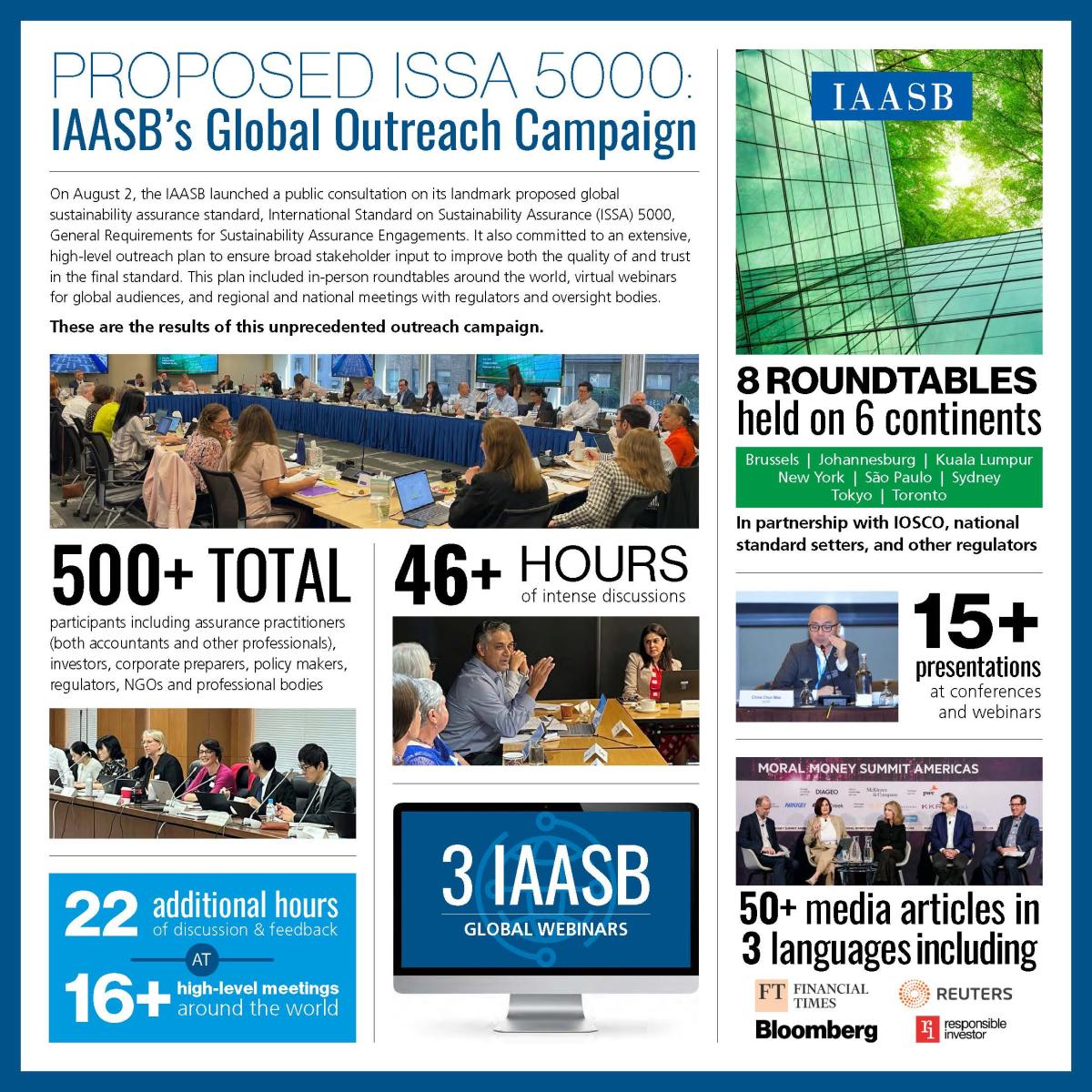
    On August 2, the International Auditing and Assurance Standards Board (IAASB) launched a public consultation on its landmark proposed global sustainability assurance standard, International Standard on Sustainability Assurance (ISSA) 5000, General Requirements for Sustainability Assurance Engagements. It also committed to an extensive, high-level outreach plan to ensure broad stakeholder input to improve both the quality of and trust in the final standard. This plan included in-person roundtables around the world, virtual webinars for global audiences, and regional and national meetings with regulators and oversight bodies.

    These are the results of this unprecedented outreach campaign:

    IAASB's proposed ISSA 5000 outreach results