  • Global Search for Volunteer Members to Join the IPSASB

    English

    The IFAC Nominating Committee has launched a global search for volunteer members to serve on the International Public Sector Accounting Standards Board® (IPSASB®), an independent standard-setting body that develops and maintains accrual-based International Public Sector Accounting Standards® (IPSAS®), IPSASB Sustainability Reporting Standards™ (IPSASB SRS™), and other high-quality reporting guidance for use by governments and public sector entities worldwide.

    The Nominating Committee is seeking nominations from a wide range of relevant backgrounds, including:

    • Public sector standard setters and external auditors;
    • Preparers of accrual-based financial statements and/or public sector sustainability reports such as from Ministries of Finance, Accountants Generals’ Departments, or other institutions;
    • Users of general-purpose financial reports, such as parliamentarians, budget officials, and credit-rating agencies; and
    • Professionals from jurisdictions that are transitioning to or have already implemented IPSAS.

    Candidates should have relevant experience, such as strong knowledge of financial or sustainability reporting issues, accounting standard-setting experience, direct involvement in public financial management reforms, and/or familiarity with the needs of financial statement users. Excellent written and spoken English is required.

    Selected members will serve an initial three-year term beginning January 1, 2027, with the possibility of renewal for an additional term.

    All stakeholders, including from national, state, and local governments, national standard setters, IFAC member organizations, the Forum of Firms and their members from public accounting firms, other organizations, and members of the general public, are encouraged to nominate candidates or apply.

    Nominations from all regions of the world are encouraged.

    “The IPSASB plays a vital role in strengthening trust, accountability, and sustainability in public financial management worldwide,” said Jon Blondal, Co-Chair of the Public Interest Committee. “Serving on the Board is an opportunity to help shape the standards that improve how governments manage public resources and report to their citizens.”

    “Supporting high-quality international standards is a core part of how we deliver value to our members and the global profession,” said Lee White, IFAC Chief Executive Officer. “The IPSASB’s work supports transparency, accountability, and trust in the public sector. We encourage professionals who share that commitment to consider serving and contributing their experience to this important work.”

    The deadline for submitting applications is January 31, 2026.

    Please see the Call for Nominations for more details and information on how to submit an application.

    About IFAC

    IFAC, by connecting and uniting its members, makes the accountancy profession truly global.

    IFAC member organizations are champions of integrity and professional quality, and proudly carry their membership as a badge of international recognition.

    IFAC and its members work together to shape the future of the profession through learning, innovation, a collective voice, and commitment to the public interest.

    About the IPSASB
    The International Public Sector Accounting Standards Board (IPSASB) works to strengthen public financial management globally through developing and maintaining accrual-based International Public Sector Accounting Standards (IPSAS Standards), IPSASB Sustainability Reporting Standards (IPSASB SRS™ Standards) and other high-quality financial reporting guidance for use by governments and other public sector entities. It also raises awareness of IPSAS Standards and IPSASB SRS Standards and promotes the adoption and implementation of these to enhance the quality and consistency of practice throughout the world and strengthen the transparency and accountability of public sector finances and sustainable development. The Board receives support from the Asian Development Bank, the Chartered Professional Accountants of Canada, the New Zealand External Reporting Board, the government of Canada, and The World Bank. The structures and processes that support the operations of the IPSASB are facilitated by the International Federation of Accountants (IFAC®). For copyright, trademark, and permissions information, please go to permissions or contact permissions@ifac.org.

    About the Public Interest Committee
    The governance and standard-setting activities of the IPSASB are overseen by the Public Interest Committee (PIC), to ensure that they follow due process and reflect the public interest. The PIC is comprised of individuals with expertise in public sector or financial reporting, and professional engagement in organizations that have an interest in promoting high-quality and internationally comparable financial information.

    About the Nominating Committee

    The Nominating Committee makes recommendations to the International Federation of Accountants (IFAC) Board on the composition of the IPSASB and other IFAC Groups. The Nominating Committee is guided in its work by the principle of selecting the most suitable candidate for the position. The Committee also seeks diversity in gender, regional, and professional background, as well as representation from jurisdictions with different levels of economic development.

    The Public Interest Committee oversees the nomination process for IPSASB membership and provides its advice. To learn more about the Nominating Committee, please visit the IFAC website

    Submit by January 31, 2026

  • Global Accountancy Leaders Converge in Mexico City to Shape the Future of the Profession

    New York | Mexico City English

    The International Federation of Accountants (IFAC) this week opens IFAC Global Connect: Better Together 2025 in Mexico City, bringing together regulators, standard setters, investors, and IFAC member organizations from across the world to strengthen the consistency and credibility of global reporting, regulatory frameworks, and the impact of AI and emerging technologies on the accountancy profession. 

    Image
    IFAC Connect Global

    Held alongside the IFAC Council meeting, this two-day, invitation-only event unites IFAC’s global members with the leadership from the International Auditing and Assurance Standards Board (IAASB), International Ethics Standards Board for Accountants (IESBA), International Public Sector Accounting Standards Board (IPSASB), and International Sustainability Standards Board (ISSB) with senior officials from IOSCO.  

    Lee White, IFAC Chief Executive Officer, said: “Rapid innovation is reshaping economies and their growth programs. We are focused on elevating and delivering the professional accountant’s role with governance, transparency, and accountability of AI. We will work with regulators and governments to align and benefit our core and common priorities —global collaboration is real progress.”

    In addition to cross-sector collaboration, a defining feature of all IFAC Connect events is the elevation of local perspectives. Latin American viewpoints will feature prominently throughout the program, with opportunities to continue networking outside of sessions hosted by IFAC member, the Instituto Mexicano de Contadores Públicos (IMCP). 

    Ludivina Leija, President, IMCP, said: “Hosting IFAC Council and Connect Global in Mexico City demonstrates the commitment of Mexico and the Latin American profession to advancing transparency, integrity, and innovation. Through this global dialogue, we are reinforcing the essential role professional accountants play in building stronger economies and more accountable institutions.” 

    IFAC Global Connect is part of the ongoing IFAC ConnectTM  series, in its second year. The next regional IFAC Connect event will be held in Jakarta in December.  

    About IFAC
    IFAC, by connecting and uniting its members, makes the accountancy profession truly global.

    IFAC member organizations are champions of integrity and professional quality, and proudly carry their membership as a badge of international recognition.

    IFAC and its members work together to shape the future of the profession through learning, innovation, a collective voice, and commitment to the public interest.

  • Global Accountancy and Legal Professions Partner to Fight Money Laundering

    Grand Cayman, Cayman Islands English

    The International Bar Association (IBA) and the International Federation of Accountants (IFAC) have today launched a pioneering new initiative aimed at supporting legal and accountancy professional bodies in the fight against money laundering. 

    This pilot workshop, which is the first in a planned global series of regional AML capacity building events, brings together representatives from the accountancy and legal professions in a shared learning environment designed to help strengthen national AML systems.

    The three-day programme, with over 70 delegates from bar associations and professional accountancy bodies from 22 jurisdictions in the Caribbean region and beyond, is being held in the Cayman Islands between October 28-30. It is supported by the Financial Action Task Force (FATF), the global AML standard setter, and CFATF, its regional affiliate, and is being hosted by the Cayman Islands Institute of Professional Accountants (CIIPA) and the Legal Services Supervisory Authority (LSSA), with the sponsorship of the Cayman Islands Ministry of Financial Services. 

    The workshop agenda, which comprises panel sessions, lectures, and collaborative breakout activities, aims to:

    • Enhance the ability of professional bodies to educate and equip their members with relevant AML requirements and expectations;
    • Empower professional associations to partner more effectively with key AML stakeholders, including government agencies and financial intelligence units; and
    • Support professional bodies in undertaking or preparing for AML supervisory responsibilities where applicable.

    Steven Richman, Chair of the IBA’s Bar Issues Commission, commented: ‘This initiative underscores the critical role that the accountancy and legal professions play in combatting money laundering and strengthening the integrity of the global financial system as a whole. Sharing ideas and working together is crucial to stamping out this corrupt practice.’

    "IFAC, by connecting and uniting its members, makes the accountancy profession’s contributions to the fight against money laundering truly global.  Through our partnership with the FATF and IBA, we aim to equip our member professional bodies with the tools and networks they need to be AML leaders in their jurisdictions," said Scott Hanson, Director of Policy & Global Engagement of IFAC.

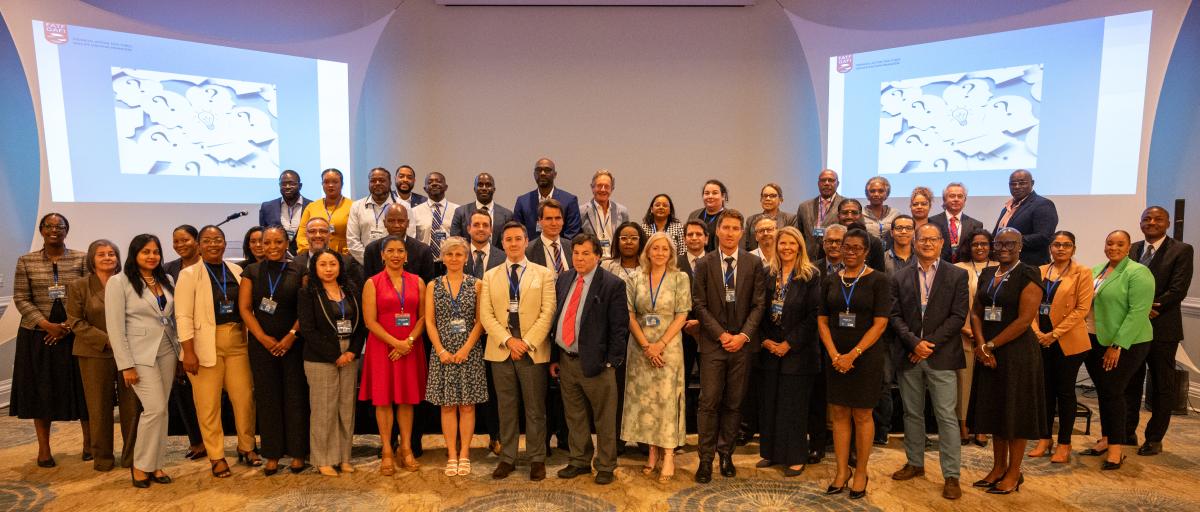
    IBA-IFAC AML Meeting Group


    Media Contact

    For further information or media inquiries, please contact:

    • Scott Hanson, Director, IFAC – scotthanson@ifac.org
    • Sara Carnegie, International Bar Association – sara.carnegie@int-bar.org

    About the International Bar Association (IBA)

    The International Bar Association (IBA), the global voice of the legal profession, is the foremost organisation for international legal practitioners, bar associations and law societies. Established in 1947, shortly after the creation of the United Nations, it was born out of the conviction that an organisation made up of the world's bar associations could contribute to global stability and peace through the administration of justice.

    About IFAC

    IFAC, by connecting and uniting its members, makes the accountancy profession truly global.

    IFAC member organizations are champions of integrity and professional quality, and proudly carry their membership as a badge of international recognition.

    IFAC and its members work together to shape the future of the profession through learning, innovation, a collective voice, and commitment to the public interest.

  • IFAC, INTOSAI, and IDI Sign Strategic MoU to Strengthen Cooperation for Public Sector Accountability and Impact

    Sharm El Sheikh, Egypt English

    The International Federation of Accountants (IFAC), the International Organization of Supreme Audit Institutions (INTOSAI), and the INTOSAI Development Initiative (IDI) have signed a Memorandum of Understanding (MoU) at the XXV INCOSAI meeting in Sharm El Sheikh, Egypt.

    The MoU formalizes collaboration between the three organizations to enhance the quality of public sector auditing and strengthen transparency and accountability in government activities—fostering good governance and promoting the economy, effectiveness, and efficiency of government programs for the benefit of all.

    The agreement underscores a shared commitment to strengthen public financial management, promote high-quality international standards, and build capacity within Supreme Audit Institutions (SAIs) and the broader accountability profession.

    Under the MoU, IFAC, INTOSAI, and IDI endeavor to :

    • Collaborate on issues of mutual interest to promote sound public financial management, support each other’s efforts to promote the adoption and implementation of their standards, and foster partnerships between INTOSAI and IFAC members to strengthen public sector accountancy and audit capacity;
    • Exchange relevant knowledge, experience, and best practices;
    • Explore opportunities to convene or contribute to joint events, forums, and dialogues to advance shared objectives and engage stakeholders;
    • Cooperate in engagements with donors and development partners to leverage synergies in capacity-building projects that support all three parties’ objectives; and
    • Promote relevant initiatives and publications.

    This partnership builds on a long history of cooperation between the global accountancy profession and the public sector audit community, recognizing their complementary roles in advancing integrity, trust, and effective governance.

    Lee White, Chief Executive Officer, IFAC said:  This MoU is a milestone in our ongoing collaboration with INTOSAI and IDI. Public sector accountability is fundamental to trust in government and citizens’ confidence in how public resources are managed. Together, we are reinforcing the bridge between the accountancy profession and Supreme Audit Institutions to strengthen integrity, transparency, and the quality of public sector reporting and assurance globally.”

    Dr Margit Kraker, Secretary General, INTOSAI said:  "INTOSAI welcomes this strengthened collaboration with IFAC and IDI. This agreement is a reflection of our mutual confidence and our conviction that collaboration is central to lasting progress. By pooling our knowledge, experience, and resources, we are laying a strong foundation for sustainable and impactful results. Let us approach this partnership with commitment and confidence — for the benefit of our institutions, our partners, and ultimately, the citizens we serve."

    Einar Gørrissen, Director General, IDI said: “As an INTOSAI body, the IDI is pleased to formalize this partnership with IFAC. Our collaboration is rooted in a shared commitment to support independent, professional, and credible Supreme Audit Institutions ensuring trust in public institutions. We look forward to working together for capacity development, standard-setting support, and advocacy, for contributing to stronger, more resilient institutions that are essential for better societies and improved lives.”

    About IFAC

    IFAC, by connecting and uniting its members, makes the accountancy profession truly global.

    IFAC member organizations are champions of integrity and professional quality, and proudly carry their membership as a badge of international recognition.

    IFAC and its members work together to shape the future of the profession through learning, innovation, a collective voice, and commitment to the public interest.

  • IPSASB Conforms its Definition of Material

    New York, New York English

    The International Public Sector Accounting Standards Board (IPSASB®), developer of IPSAS® Standards, international accrual-based accounting standards for use by governments and other public sector entities around the world, has issued Definition of Material (Amendments to IPSAS 1, IPSAS 3, and the Conceptual Framework).

    “The amendments aim to bring consistency into our guidance on the definition of material, helping organizations apply it more effectively,” said Ian Carruthers, IPSASB Chair. "A clear and well-understood definition will serve as a solid foundation for our planned guidance on how to make materiality judgments to be developed during the second phase of this project.”

    The amendments:

    • Clarify that an entity is required to consider the information needs of primary users instead of other users of GPFRs; and
    • Align the definition of material in IPSAS 1, Presentation of Financial Statements, with Chapter 3 of the Conceptual Framework on Qualitative Characteristics.

    The amendments will help strengthen accountability by ensuring financial statements focus on information most relevant to primary users. They will enhance consistency through conforming the definition of the term material between the Conceptual Framework and within IPSASB’s authoritative guidance and lay the foundation for planned guidance on materiality judgments in financial and reporting.

    The second phase of the project includes developing non-authoritative guidance aligned with IFRS® Practice Statement 2, Making Materiality Judgements, to efficiently and promptly address constituents' need for additional guidance on making materiality judgments when preparing financial statements in accordance with IPSAS Standards.

    The amendments to IPSAS Standards in the Definition of Material (Amendments to IPSAS 1, IPSAS 3, and the Conceptual Framework) are effective January 1, 2027. An earlier application is permitted. The amendments to the Conceptual Framework are effective immediately.

    About the IPSASB
    The International Public Sector Accounting Standards Board (IPSASB) works to strengthen public financial management globally through developing and maintaining accrual-based International Public Sector Accounting Standards (IPSAS Standards), IPSASB Sustainability Reporting Standards (IPSASB SRS™ Standards) and other high-quality financial reporting guidance for use by governments and other public sector entities. It also raises awareness of IPSAS Standards and IPSASB SRS Standards and promotes the adoption and implementation of these to enhance the quality and consistency of practice throughout the world and strengthen the transparency and accountability of public sector finances and sustainable development. The Board receives support from the Asian Development Bank, the Chartered Professional Accountants of Canada, the New Zealand External Reporting Board, the government of Canada, and The World Bank. The structures and processes that support the operations of the IPSASB are facilitated by the International Federation of Accountants (IFAC®). For copyright, trademark, and permissions information, please go to permissions or contact permissions@ifac.org.


    About the Public Interest Committee
    The governance and standard-setting activities of the IPSASB are overseen by the Public Interest Committee (PIC), to ensure that they follow due process and reflect the public interest. The PIC is comprised of individuals with expertise in public sector or financial reporting, and professional engagement in organizations that have an interest in promoting high-quality and internationally comparable financial information.

  • IFAC’s Global Investor Group (GIG) Holds Inaugural Meeting in Tokyo to Enhance Investor-Auditor Dialogue

    Tokyo / London / New York English

    The International Federation of Accountants (IFAC) convened the inaugural meeting of the Global Investor Group (GIG) in Tokyo on October 20, 2025, bringing together senior leaders from the investor community, the global accountancy profession, regulators, and capital market institutions. IFAC’s GIG aims to foster open and ongoing dialogue between the profession and investors to ensure assurance remains trusted, relevant, and aligned with the evolving needs of capital markets.

    The first meeting was graciously hosted by the Japanese Institute of Certified Public Accountants (JICPA) and held with the support of Norges Bank Investment Management (NBIM), the Japan Exchange Group (JPX)/Tokyo Stock Exchange, and under the endorsement of the Japanese Financial Services Agency (JFSA) as part of Japan Weeks 2025.

    Naruhito Minami, Chair and President of the JICPA said in his welcome address: “Dialogue between investors and auditors is not just about information exchange — it is about strengthening trust, improving audit quality, and enhancing transparency. At JICPA, we believe that providing reliable sustainability information is essential for investors to evaluate a company's long-term value creation. Consequently, the roles of auditors and the scope of dialogue between investors and auditors are expanding.

    Today’s discussions confirmed why the Global Investor Group GIG matters — the profession and investors share the same ultimate goal: trustworthy, relevant information that supports sound decision-making,” said Lee White, IFAC Chief Executive Officer. “GIG is about creating a trusted space for real dialogue between investors and the accountancy profession — open, honest, and focused on solutions. By aligning investor needs and market priorities, we can help close the expectation gap with assurance and strengthen the trust and transparency that global markets depend on.”

    This was echoed by Koji Watanabe, Director of the Listing Department, Tokyo Stock Exchange, Inc. (TSE), who added “Exchanges, regulators, auditors, and companies all share the responsibility to provide information that is accurate, timely, and useful. The Global Investor Group is a timely initiative. By working together, we can make audit reports more useful, connect sustainability information to financial statements, and build stronger partnerships in our markets. I hope today’s discussion will start a stronger partnership between investors and auditors, and help strengthen capital markets worldwide.”

    The Chief Accountant, Director for International Accounting of the JFSA, Koichiro Kuramochi noted: “Hosting such international dialogue here in Japan is not only timely, but also essential to deepening mutual understanding and collaboration with global market participants. The Japan FSA places great importance on engaging with overseas investors and stakeholders in the capital markets. We are committed to strengthening these communications further, and today’s meeting marks a significant step forward in that direction. We hope that it will serve as a foundation for future collaboration between investors and the accounting profession.”

    Jeanne Stampe, Lead Policy Advisor, Active Ownership at Norges Bank Investment Management concluded: “In an increasingly complex investment landscape, audit reports provide investors with critical insights into the judgments and assumptions underlying financial results. Alignment between investors and the auditor community will empower investors to engage effectively with board audit committees. The GIG can facilitate constructive dialogue on enhancing how audit findings reach investors, ultimately strengthening governance and supporting better capital allocation decisions.

    The meeting focused on how to help bridge the assurance expectation gap—the difference between what investors expect from assurance and what the profession delivers or is perceived to deliver. Through a structured roundtable held under the Chatham House Rule, participants explored critical questions about the role of assurance in enhancing trust, especially regarding:

    • The connectivity between sustainability-related and financial information and their assurance,
    • Audit scope, Key Audit Matters and independence,
    • Engagement with audit committees, and
    • Transparency in auditor communications.

    The GIG’s primary objective is to serve as a trusted, informal forum where investors and assurance providers can engage openly.

    In terms of next steps, input from this inaugural meeting will help shape the Terms of Reference of the GIG and its 2026 workplan, and ensure the GIG remains responsive to both investor priorities and market developments.

    About IFAC
    IFAC, by connecting and uniting its members, makes the accountancy profession truly global.

    IFAC member organizations are champions of integrity and professional quality, and proudly carry their membership as a badge of international recognition.

    IFAC and its members work together to shape the future of the profession through learning, innovation, a collective voice, and commitment to the public interest.

  • IPSASB Consults on its Future Work Program Projects

    New York, New York English

    The International Public Sector Accounting Standards Board® (IPSASB®) has published its Work Program Consultation. Having set its overall strategy for the period 2024-2028 through a public consultation, this new Consultation seeks to understand stakeholders’ greatest needs in relation to individual financial reporting projects, post implementation reviews and sustainability reporting projects. By engaging with its stakeholders, the IPSASB aims to ensure its future work program projects are responsive, relevant, and aligned with the evolving needs of the global public sector.

    IPSASB-2025-WPC
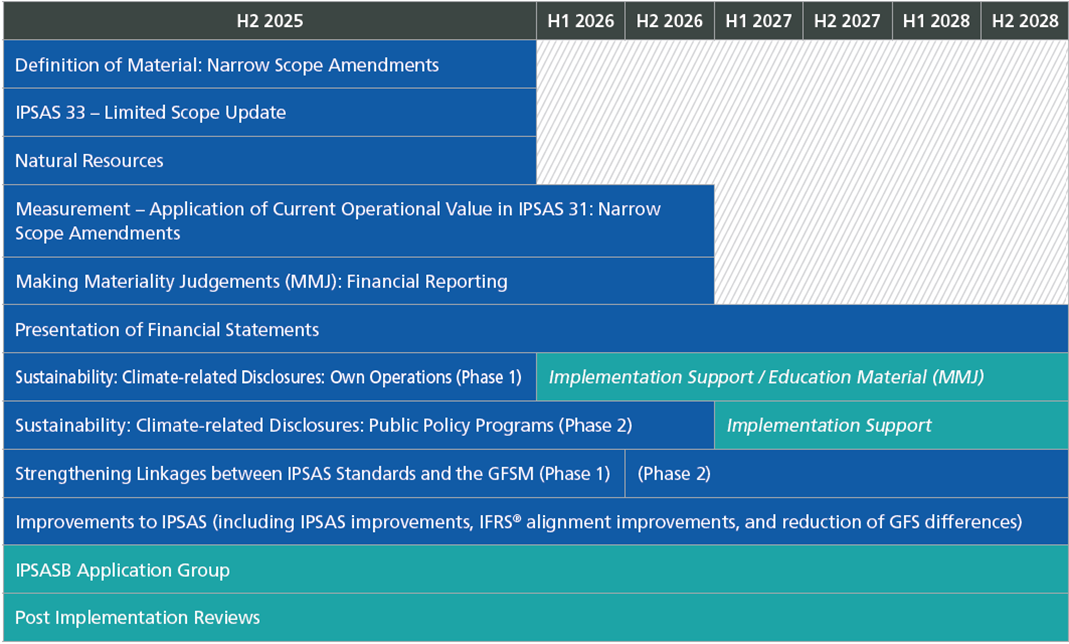
    IPSASB Current Work Program 2025-2028. Items in blue represent current ongoing IPSASB financial reporting and sustainability reporting projects. Items in green represent ongoing items primarily related to implementation and education support activities which utilize IPSASB resources - including maintenance activities. The bars represent the expected timing of completion for all ongoing projects, and the expected commencement and completion for new projects.

    “Understanding the greatest needs of stakeholders will allow the Board to determine how best to deploy resources as they become available,” said Ian Carruthers, IPSASB Chair. “With resources to undertake new initiatives anticipated to become available during 2026 and onwards, the IPSASB decided that now is the time to consult with stakeholders to determine their future project needs.”

    IPSASB will take decisions during 2026 on the individual projects to add to its future work program based on stakeholder feedback from the consultation that last until May 4, 2026, bearing in mind the available Board resources.


    How to Access
    Access the IPSASB’s Work Program Consultation. The IPSASB encourages IFAC members, associates, and Network Partners to promote the availability of the Work Program Consultation and encourages all interested stakeholders to respond to inform the IPSASB as it sets it next Work Program.

    About the IPSASB
    The International Public Sector Accounting Standards Board (IPSASB) works to strengthen public financial management globally through developing and maintaining accrual-based International Public Sector Accounting Standards (IPSAS Standards), IPSASB Sustainability Reporting Standards (IPSASB SRS™ Standards) and other high-quality financial reporting guidance for use by governments and other public sector entities. It also raises awareness of IPSAS Standards and IPSASB SRS Standards and promotes the adoption and implementation of these to enhance the quality and consistency of practice throughout the world and strengthen the transparency and accountability of public sector finances and sustainable development. The Board receives support from the Asian Development Bank, the Chartered Professional Accountants of Canada, the New Zealand External Reporting Board, the government of Canada, and The World Bank. The structures and processes that support the operations of the IPSASB are facilitated by the International Federation of Accountants (IFAC®). For copyright, trademark, and permissions information, please go to permissions or contact permissions@ifac.org.

    About the Public Interest Committee
    The governance and standard-setting activities of the IPSASB are overseen by the Public Interest Committee (PIC), to ensure that they follow due process and reflect the public interest. The PIC is comprised of individuals with expertise in public sector or financial reporting, and professional engagement in organizations that have an interest in promoting high-quality and internationally comparable financial information.

  • IFAC Announces New Chairs for Key Advisory Groups Driving the Global Accountancy Profession

    New York, New York English

    The International Federation of Accountants (IFAC) today announced the appointment of Helene Agélii (Sweden) as Chair of the Small and Medium Practices Advisory Group (SMP AG), Sinéad Donovan (Ireland) as Chair of the International Panel on Accountancy Education (IPAE), and Josephine Okui Ossiya (Uganda) as Chair of the Professional Accountants in Business Advisory Group (PAIB AG). Each brings a wealth of leadership experience and proven records of advancing the global accountancy profession.

    “We are delighted to welcome Sinéad, Josephine, and Helene—three outstanding members of the global accountancy community,” said Jean Bouquot, IFAC President. “Each has demonstrated exceptional leadership in advancing our profession and supporting the public interest, our members, and our collective mission. Their perspectives will be invaluable as we work together to shape the future of accountancy through learning, innovation, and a collective voice. I also extend my deep gratitude to the outgoing chairs for their dedicated service and impactful contributions.”

    Ms. Helene Agélii, Incoming Chair, Small and Medium Practices Advisory Group

    Ms. Agélii arrives with extensive experience in a variety of leadership roles in the accountancy profession. As Secretary General of the Nordic Federation of Public Accountants, she has deepened the collaborative relationships between the national accountancy bodies in the Nordic countries and, on the global stage, was a strong advocate for the development of an international auditing standard suitable for smaller and less complex entities—a need that was subsequently recognized and addressed by the International Auditing and Assurance Standards Board (IAASB). Ms. Agélii previously served as general counsel for the Swedish Institute for Professional Accountants (FAR), as a technical advisor to the IAASB, as a member of the International Ethics Standards Board for Accountants (IESBA), and in multiple capacities with IFAC, including within the SMP AG. She has applied her background in law as an expert advisor for Swedish government bodies on implementing EU audit regulations into Swedish law.

    Ms. Sinéad Donovan, Incoming Chair, International Panel on Accountancy Education

    Ms. Donovan brings with her a distinguished record in professional leadership and contribution to the accountancy profession. As former Chair and Partner at Grant Thornton Ireland, Ms. Donovan led the firm through transformative growth across multiple international markets. She has been significantly involved in the development of the accountancy profession in Ireland, including terms as President of Accounting Technicians Ireland and Chartered Accountants Ireland (CAI), the latter coinciding with the amalgamation of CAI and CPA Ireland. Her longstanding commitment to accountancy education includes serving as Chair of the Education Board at CAI, where she championed curriculum modernization and university engagement.

    Mrs. Josephine Okui Ossiya, Incoming Chair, Professional Accountants in Business Advisory Group

    Mrs. Josephine Okui Ossiya brings a distinguished record of leadership in finance, capital markets, and governance across Africa. Currently serving as Chief Executive Officer of the Capital Markets Authority Uganda, she has held senior executive roles including Chief Finance Officer of Bujagali Energy Limited, Finance Director at Eskom Uganda, and CFO and Head of Finance at ATC Ghana. A committed leader in the accountancy profession, Mrs. Ossiya is the immediate Past President of Council of the Institute of Certified Public Accountants of Uganda, a Fellow of ACCA (UK), and a founding member of the Institute of Internal Auditors Uganda. She also contributes to public service through her board role at the Bank of Uganda, where she chairs key committees, and through her work in education and entrepreneurship.

    Nominated by IFAC’s member organizations, these new chairs represent some of the profession’s most respected leaders and reinforce the global reach of IFAC’s network. Together with its members, IFAC works to shape the future of accountancy through learning, innovation, and a collective voice—always with a commitment to integrity, quality, and the public interest. Membership in IFAC is not only a mark of international recognition, but also a symbol of the profession’s unity and shared responsibility as a truly global force.

    About IFAC

    IFAC, by connecting and uniting its members, makes the accountancy profession truly global.

    IFAC member organizations are champions of integrity and professional quality, and proudly carry their membership as a badge of international recognition.

    IFAC and its members work together to shape the future of the profession through learning, innovation, a collective voice, and commitment to the public interest.

  • IESBA Conference 2025 Videos and Speeches Now Available - Marking Global Ethics Day 2025

    English

    All speeches and session videos from the IESBA Ethics and Independence Conference 2025 are now available on the conference website, offering open access to the key discussions and insights shared.

    With about 800 participants - including more than 200 in-person attendees and 35 speakers and moderators from around the world - the conference was a milestone in the global dialogue on the relevance of ethics in the accounting services industry and the financial sector.

    Keynotes and panels addressed:

    • Ethical Conduct and Information Quality in Accounting and Auditing: Safeguarding Market Confidence
    • The Importance of Ethics in Building Trust in Global Financial Markets
    • Ethics in a World of Regulatory Shifts and Market Transformation
    • Trust and Transparency in Capital Markets
    • Ethical Culture and Governance – Reinforcing Resilience and Public Trust in Accounting Firms
    • Ethics vs. Innovation? The Future of Technology in Audit and Accounting
    • The Rise of Private Equity in Accounting: Strategic Partnerships or Increased Risks to Public Interest?
    • Accountants at a Crossroads: Ethics and the Fight Against Financial Crime
    • How to Enhance Trust in the Audit Market: a European Perspective

    This content is part of a series of initiatives the IESBA will promote throughout October to celebrate Global Ethics Day 2025 (October 15), under the theme “Ethics Re-Envisioned.”

    The conference discussions provide valuable contributions to the ongoing reflection on how we can, and should, re-envision the increasingly relevant role of ethics across the accounting profession and the broader financial system.

    Throughout the month, the IESBA will invite its community to engage and contribute to the discussion through a series of initiatives, including dedicated videos and polls on each panel topic, content exploring how ethics can be re-envisioned, and highlights of IESBA’s ongoing efforts to strengthen stakeholder engagement and deliver greater public value.

    Stay tuned to IESBA on LinkedIn for updates and opportunities to join the conversation.

  • Now Available: IESBA Handbook 2025 Edition

    New York, NY English

    The International Ethics Standards Board for Accountants (IESBA) today released the 2025 Handbook of the International Code of Ethics for Professional Accountants (including International Independence Standards). This handbook incorporates the tax planning pronouncement that became effective for tax planning services and activities beginning after June 30, 2025.

    The back of Volume 1 of the 2025 Handbook contains the IESBA-approved revisions to the Code addressing Using the Work of an External Expert as well as Sustainability Reporting-related Revisions. These revisions will become effective December 2026.

    The new Volume 2 of the IESBA Handbook contains the International Ethics Standards for Sustainability Assurance (including Independence Standards) and Other Revisions to the Code Relating to Sustainability Assurance and the provisions addressing Using the Work of an External Expert. These provisions become effective December 2026, except for certain independence provisions relating to value chain, which become effective July 2028.

    Click here to learn more about the IESBA Code.


    Reproducing and Translating the IESBA Handbook

    To help adoption and implementation of the IESBA standards, stakeholders are invited to submit requests for permission to reproduce or translate the IESBA Handbook via the Online Permissions Requests or Inquiries system on the IFAC website.

    About IESBA

    The International Ethics Standards Board for Accountants (IESBA) is an independent global standard-setting board. The IESBA’s mission is to serve the public interest by setting high-quality, international ethics (including independence) standards as a cornerstone to ethical behavior in business and organizations, and to public trust in financial and non-financial information that is fundamental to the proper functioning and sustainability of organizations, financial markets and economies worldwide.

    Along with the International Auditing and Assurance Standards Board, the IESBA is part of the International Foundation for Ethics and Audit. The Public Interest Oversight Board (PIOB) oversees IESBA and IAASB activities and the public interest responsiveness of the standards. 

    Digital Access and Print Orders Available