  • IESBA launches Firm Culture and Governance Viewpoints as it begins Asia outreach

    Global English
    • IESBA launches its Viewpoints on Firm Culture and Governance, initiating a six-month global dialogue on the drivers of ethical culture in accounting firms.
    • The launch coincides with IESBA’s Asia outreach to Singapore, Malaysia and Hong Kong SAR, engaging with regulators, professional bodies, firms, investors, CFOs and others on priorities shaping the profession in 2026.
    • Discussions will focus on IESBA’s strategy for 2028–2031, sustainability-related ethics standards, lessons from the implementation of existing standards, firm culture and governance, private equity investment, technology and emerging ethical risks and trends.

    The International Ethics Standards Board for Accountants (IESBA) today began a high-level outreach visit to Singapore, Malaysia and Hong Kong SAR, marked by the launch of its Viewpoints on eight fundamental elements of an ethical culture and governance framework for accounting firms. Learn more about the Firm Culture and Governance Project here.

    The IESBA Viewpoints are designed to support global dialogue on key characteristics of elements such as ethical leadership, governance or incentives which influence ethical culture and behavior in accounting firms, informing the planned development of a global baseline.

    Key topics on the agenda also include international and regional standard-setting developments, sustainability-related standards, lessons from the implementation of the Responding to Non-compliance with Laws and Regulations (NOCLAR) standard and the restructured IESBA Code, as well as technology-driven change and private equity investment in accounting firms.

    During the visit, IESBA will engage with a broad range of stakeholders, including regulators, professional accountancy organizations, standard setters, accounting firms, investors, chief financial officers, professional accountants, authorities responsible for market integrity and the prevention of financial crime and others.

    The outreach reflects Asia’s central role in the adoption and implementation of international ethics standards and the region’s importance to the global financial system and to IESBA’s work.

    “Asia is at the forefront of many of the developments reshaping the accounting profession and the broader financial sector — from sustainability and technology to evolving business models and regulatory expectations,” said Gabriela Figueiredo Dias, Chair of IESBA. “This outreach is an opportunity to listen, exchange views and deepen engagement with stakeholders in a leading region who are shaping how ethics is applied in practice across the region.”

    Firm Culture and Governance Viewpoints and Dialogues

    The IESBA Viewpoints on Firm Culture and Governance, published today, respond to growing recognition that ethical behavior is shaped not only by rules and individual conduct, but also by organizational factors such as leadership, governance, accountability, incentives, openness and transparency, among others.

    The Viewpoints are not a proposed framework. They are intended to stimulate reflection, learning and engagement, and to support informed dialogue on what a future global framework on firm culture and governance should look like.

    Their publication marks the start of the Firm Culture and Governance Dialogues, a six-month global engagement initiative through which IESBA will test, refine and further develop its thinking in close consultation with stakeholders.

    Supporting materials released include:

    • A booklet presenting the Viewpoints on the eight elements of the Firm Culture and Governance Framework and outlining the objectives of the project and the dialogues planned for the first half of 2026;
    • A Snapshot providing a short, non-technical overview of the project, the Viewpoints, upcoming discussions and key decisions expected in 2026;
    • A Briefing Note setting out the Viewpoints, their context and objectives, engagement questions and next steps; and
    • A high-level paper outlining linkages between the Viewpoints and International Standard on Quality Management 1 (ISQM 1).

    “Trust has become a defining strategic asset. Organizations are increasingly judged not only on technical excellence or commercial success, but also on the values they demonstrate, the judgments they exercise under pressure, and the confidence they earn from markets, regulators, investors and society at large,” said Ms. Figueiredo Dias. “The IESBA Viewpoints are intended to support reflection and dialogue on principles that can reinforce trust and resilience.”

    Asia outreach: meetings across Singapore, Malaysia and Hong Kong

    During the January outreach, IESBA will engage with stakeholders across Singapore, Malaysia and Hong Kong, including professional accountancy organizations, regulators, standard setters, accounting firms, investors, CFOs, professional accountants, public authorities responsible for market integrity and financial crime prevention and others.

    Singapore | 12–13 January 2026

    The outreach begins in Singapore with meetings at the Institute of Singapore Chartered Accountants (ISCA), covering IESBA’s strategic direction, sustainability reporting, lessons from the implementation of NOCLAR and the restructured IESBA Code, and the IESBA Viewpoints on Firm Culture and Governance. A dedicated engagement with Chief Financial Officers will address ethical challenges facing professional accountants in business or others who operate in this or equivalent role.

    IESBA will meet with the Association of Chartered Certified Accountants to discuss current priorities and projects.

    On 13 January, IESBA will participate in a full-day program hosted by the Accounting and Corporate Regulatory Authority (ACRA), featuring discussions on IESBA’s strategy and key projects, panels on firm culture and governance and private equity investment in accounting firms, a fireside chat on technology and innovation, and further exchanges on lessons from implementation of IESBA Standards.

    Malaysia | 15–16 January 2026

    In Malaysia, IESBA will meet with the Malaysian Institute of Accountants (MIA) to discuss IESBA’s strategic direction, the adoption of the IESBA Code, as well as the challenges and ethical pressures facing the profession.

    IESBA will also meet with the Securities Commission Malaysia (MY SECCOM), with discussions focusing on firm culture and governance, sustainability-related ethics, NOCLAR and emerging risks affecting trust and market integrity. 

    Dedicated sessions hosted at MY SECCOM, will include discussions with The Malaysian Institute Of Certified Public Accountants, the Confederation of Asian and Pacific Accountants and Institutional Investors Council, as well as accounting firms and professional accountants in business to discuss national and regional priorities, as well as IESBA’s work plan, including the IESBA Viewpoints on Firm Culture and Governance and the future development of a practical global Framework, sustainability reporting, NOCLAR and other topical issues and trends.

    Hong Kong SAR | 19–21 January 2026

    The final leg of the visit will take place in Hong Kong SAR and will include a full-day program with the Hong Kong Institute of Certified Public Accountants (HKICPA), as well as meetings with the Securities and Futures Commission (SFC), the Accounting and Financial Reporting Council (AFRC), the Independent Commission Against Corruption (ICAC) and the Asian Corporate Governance Association (ACGA).

    Discussions will address IESBA’s priorities going forward, the IESBA Code, the Viewpoints and the broader Firm Culture and Governance Project, and the role of ethics and professional judgment in combating financial crime.

    About IESBA

    The International Ethics Standards Board for Accountants (IESBA) is an independent global standard-setting board. The IESBA’s mission is to serve the public interest by setting high-quality, international ethics (including independence) standards as a cornerstone to ethical behavior in business and organizations, and to public trust in financial and non-financial information that is fundamental to the proper functioning and sustainability of organizations, financial markets and economies worldwide.

    Along with the International Auditing and Assurance Standards Board (IAASB), the IESBA is part of the International Foundation for Ethics and Audit (IFEA). The Public Interest Oversight Board (PIOB) oversees IESBA and IAASB activities and the public interest responsiveness of the standards.


    Media Contacts:

    Rui Peres Jorge 
    Director of Strategic Communications 
    International Ethics Standards Board for Accountants (IESBA) 
    ruiperesjorge@ethicsboard.org | Direct: +351 966-301-383

    David Johnson 
    Senior Manager
    IESBA Communications
    davidjohnson@ethicsboard.org | Direct: +1 (212) 471-8732
  • 2026 Edition of the Handbook of International Education Standards Now Available from IFAC

    New York, New York English

    The International Federation of Accountants (IFAC) is pleased to announce the publication of the 2026 edition of the Handbook of International Education Standards. This new edition compiles the full suite of International Education Standards (IES) 1–8, along with the supporting Framework and Glossary, and incorporates all recently revised and updated standards.

    The 2026 Handbook is organized to support the consistent adoption and implementation of the IESs, which establish the principles, concepts, and requirements that underpin high-quality accountancy education worldwide.

    This edition includes:

    • The Framework for International Education Standards, which outlines the foundational concepts for developing and maintaining professional competence.
    • A Glossary of Terms, providing essential definitions used across the standards.
    • IESs 1–6, addressing entry requirements to professional accounting education programs and the initial professional development of aspiring professional accountants.
    • IES 7, Continuing Professional Development, establishing requirements for lifelong learning for all professional accountants.
    • IES 8, Professional Competence for Engagement Partners, which outlines the competence demands for engagement partners responsible for audits of financial statements.
    • Revisions to IES 2, 3, 4 and 6 aimed at strengthening global consistency in formal assessment and supporting emerging skills needs in areas including ethics and sustainability.

    This Handbook includes revised standards that become effective on July 1, 2026 and replaces the 2019 edition.

    The new Handbook is available for download on the IFAC website.

    About IFAC
    IFAC, by connecting and uniting its members, makes the accountancy profession truly global.

    IFAC member organizations are champions of integrity and professional quality, and proudly carry their membership as a badge of international recognition.

    IFAC and its members work together to shape the future of the profession through learning, innovation, a collective voice, and commitment to the public interest.

    Updated Edition Includes All Recent Revisions; Available for Digital Access and Print Orders

  • IAASB Issues Narrow-Scope Amendments Related to IESBA’s Using the Work of Experts

    English

    The International Auditing and Assurance Standards Board (IAASB) has published narrow-scope amendments to its standards arising from the International Ethics Standards Board for Accountants’ (IESBA) Using the Work of an External Expert project.

    These amendments respond to the IESBA’s recently approved revisions to its International Code of Ethics for Professional Accountants (including International Independence Standards), which introduced, among other provisions, explicit ethical requirements for using the work of external experts in audit, assurance, and non-assurance engagements. The IAASB’s updates reflect ongoing collaboration and coordination between the IAASB and IESBA and help to maintain interoperability between the IAASB standards and the IESBA Code.

    The targeted amendments affect the following IAASB standards:

    • ISA 620, Using the Work of an Auditor’s Expert
    • ISRE 2400 (Revised), Engagements to Review Historical Financial Statements
    • ISAE 3000 (Revised), Assurance Engagements Other than Audits or Reviews of Historical Financial Information
    • ISRS 4400 (Revised), Agreed-upon Procedures Engagements

    To learn more and access the amendments and Basis for Conclusions, visit the IAASB website.

    About the IAASB
    The International Auditing and Assurance Standards Board develops auditing, assurance, related services, and quality management standards and guidance in the public interest that support consistent performance of quality engagements. Along with the International Ethics Standards Board for Accountants, the IAASB is part of the International Foundation for Ethics and Audit. The Public Interest Oversight Board oversees IAASB and IESBA activities and the public interest responsiveness of the standards. For copyright, trademark, and permissions information, please visit Permissions.

  • The IESBA Decoding Ethics Podcast

    English

    "Decoding Ethics: Building trust in a tech-driven world" is a podcast of the International Ethics Standards Board for Accountants (IESBA) exploring the technological and ethical risks and opportunities shaping the future of accounting and finance. Through in-depth conversations with global thought leaders, Decoding Ethics helps professionals navigate change and lead with integrity in a tech-driven world.


    Episode 3 -  AI and Ethics in Accounting: The Need for Human Judgment

    This episode explores the ethical implications of artificial intelligence in the accounting profession. Jeanne Viljoen is joined by Alistair Brisbourne and Sarah Lane from the ACCA Policy and Insights team to discuss real-world dilemmas finance professionals are beginning to face.

    Drawing on insights from ACCA’s recent AI Monitor report, the conversation examines how AI is already embedded in everyday accounting tools, the ethical risks this creates, and why professional judgment remains essential. The discussion also highlights practical guidance for navigating issues such as data confidentiality, automation bias, and the governance challenges organizations face when adopting AI.


    Episode 2 - Quantum is Coming!

    Quantum computing is no longer science fiction. With experts predicting operational quantum computers as early as 2029, the implications for data security, encryption, and professional trust are rapidly becoming very real.

    In this episode of Decoding Ethics, host Jeanne Viljoen is joined by Clinton Firth, a cybersecurity and digital trust partner at PwC whose experience spans national security, intelligence, and enterprise risk, to unpack what quantum computing actually is—and why it matters now for the accounting profession.


    Episode 1 - How can ethics keep pace with innovation?

    In the first episode of "Decoding Ethics: Building trust in a tech-driven world", recorded live at the inaugural IESBA Ethics & Independence Conference in Lisbon, IESBA brings together leaders from EY, KPMG UK, and Responsible Intelligence to explore the impact of AI on audit and accounting, the importance of principle-based standards, and why trust is essential for technology to drive sustainable innovation in a tech-driven world.


    Decoding Ethics is available on SpotifyApple Podcasts, and YouTube.

  • AI in Finance & Accounting — New IFAC Video Series

    New York, New York English

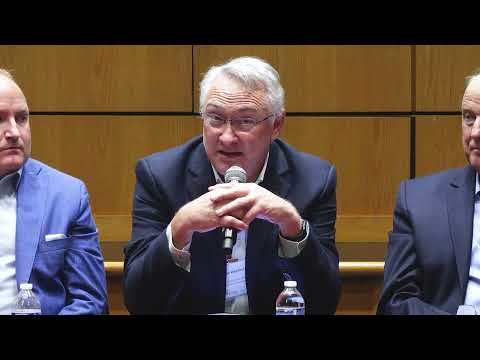
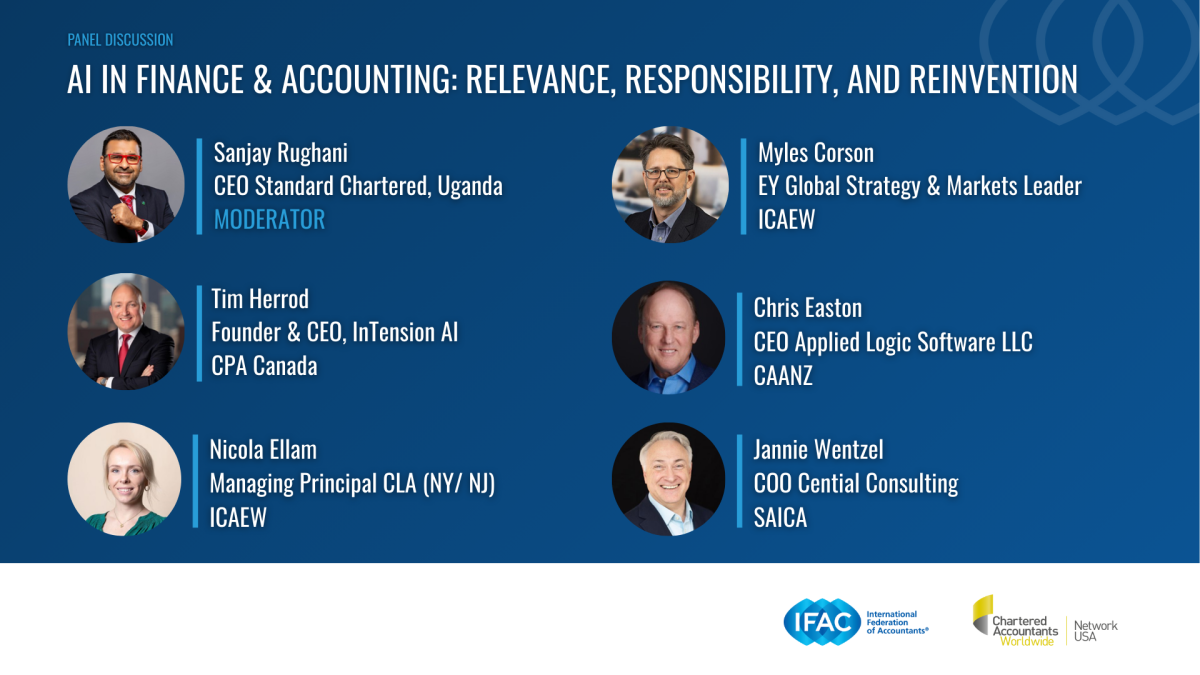
    Alongside IFAC’s recent Professional Accountants in Business (PAIB) Advisory Group meeting, we co-hosted a special side event in collaboration with Chartered Accountants Worldwide (CAW) Network USA at Fordham University.

    IFAC-CAW-AI

    This joint engagement brought together perspectives from practice, industry, technology, and academia, enabling an insightful exchange on the real-world impacts of AI on business and the accountancy profession, how our work is evolving, and what we need to do to remain relevant in the future. It featured practical observations, real examples, and candid reflections from a panel of global experts leading AI-enabled change within their organizations and with clients.

    We have compiled five short videos that capture the key themes from the panel discussion. These digestible clips reflect on how AI is influencing the pace of change, the evolving role of accountants, the importance of trust and design, and emerging leadership responsibilities.

    These informed reflections and perspectives come from leaders immersed in digital and business-model transformation. Their views provide a timely snapshot of the current AI landscape and the urgent considerations shaping the profession’s future.

    Watch them now

    Explore more insights from the IFAC Professional Accountants in Business Advisory Group.

    About IFAC

    IFAC, by connecting and uniting its members, makes the accountancy profession truly global.

    IFAC member organizations are champions of integrity and professional quality, and proudly carry their membership as a badge of international recognition.

    IFAC and its members work together to shape the future of the profession through learning, innovation, a collective voice, and commitment to the public interest.

    Relevance, Responsibility, and Reinvention

  • Asia Leads Global Confidence in Tax Fairness but Trust Gaps Persist Elsewhere in the World

    English

    Public trust in tax remains strongest in Asia – particularly South-East Asia – and the  Anglophone Pacific (Australia, Canada, New Zealand), driven by digital access and transparency. In contrast, Europe and Latin America show less confidence in the fiscal contract between citizens and the state, according to the new survey findings. 

    Public Trust in Tax 2025: Asia and Beyond, produced by the Association of Chartered Certified Accountants (ACCA), the International Federation of Accountants (IFAC), Chartered Accountants Australian and New Zealand (CA ANZ) and the Organisation for Economic Cooperation and Development (OECD), surveyed more than 12,000 individuals across 29 countries, primarily in Asia but also in Latin America, Western Europe and the Pacific.  The report explores perceptions and personal experiences of taxation, as well as attitudes towards tax competition and co-operation to provide insights into public confidence in tax systems. 

    Discussed during a panel session at the IFAC Connect ASIAPAC 2025 event in Jakarta on December 4, the survey results reveal that taxpayers across Asia largely view their tax systems as equitable and are significantly more confident that their taxes deliver fair public value compared to survey respondents across other regions. 

    Across all 29 countries surveyed, respondents were more likely to view tax as a contribution to their community rather than a cost, indicating strong support for the fiscal contract in theory. This sentiment was strongest in South-East Asia, where nearly two-thirds (64.7%) agreed. 

    Looking at the fiscal contract in practice in almost two thirds of the countries in Asia, respondents were more like to agree that tax revenues are spent for the public good, compared to only a third of the countries beyond Asia, underscoring that trust still needs to be earned through transparency and effective service delivery. 

    This finding is consistent with the results regarding public perceptions of the tax system. In three quarters of the countries in Asia respondents were more likely to agree that their tax system is equitable, compared to less than a quarter of the countries beyond Asia.  

    Across all countries, respondents reported that the most effective aspect of tax administration was digital tax services, while satisfaction with tax authority communication was much lower in Latin America and Western Europe than in Asia. Clear communication appears to matter as respondents who found tax authority messages easy to understand were four times more likely to trust the authority. 

    Across all regions, accountants remain the most trusted source of information on tax, while politicians and social media continue to rank the lowest. This credibility gap reinforces the vital role of professional accountants in shaping public understanding of fairness, ethics, and accountability in taxation. 

    Support for international co-operation on tax policy is strong globally, with respondents favouring collaboration over competition to create more coherent global tax systems. In Asia, there is also robust support for using fiscal policy to drive sustainable development, especially for infrastructure and green energy projects. 

    Helen Brand OBE, Chief Executive of ACCA, said: “Asia’s strong public trust in taxation offers valuable lessons for the world. People here see tax as a contribution to the community, not just a cost, but that trust can’t be taken for granted. Transparency, fairness, and visible returns for taxpayers are what sustain confidence in the fiscal contract over the long run.” 

    Lee White, Chief Executive Officer of IFAC, added: “Trust is the foundation of every tax system. This report reminds us that confidence in the fiscal contract is strong, but it must be continually earned. As the most trusted voices in tax, professional accountants play a vital role in upholding that trust—through integrity, sound judgement, and a commitment to the public interest.” 

    Ainslie van Onselen, Chief Executive Officer of CA ANZ, said: “Public trust in tax is the bedrock of a fair, functioning economy. These results show that when people see transparent, tangible benefits – whether it’s funding for essential services or driving sustainable growth – they’re more willing to engage. The accountancy profession has a critical role to play as insightful and trusted advisers, supporting collaboration with policymakers and tax authorities to achieve outcomes in the public interest.” 

    Manal Corwin, Director of the OECD Centre for Tax Policy and Administration, commented: “This is the first phase of a new project for the OECD looking at tax morale in Asia. We will discuss these results with governments in the region over the next year to identify the drivers of trust in tax across Asia, and best practices to build trust. This will help governments design fairer, more responsive and more coherent tax systems.”  

    Public Trust in Tax 2025: Asia and Beyond is jointly produced by the Association of Chartered Certified Accountants (ACCA), the International Federation of Accountants (IFAC), Chartered Accountants Australia and New Zealand (CA ANZ), and the OECD.  

    Join the launch event 
    Join ACCA, IFAC, CA ANZ, and the OECD on 11 February 2026 for the launch webinar of Public Trust in Tax 2025:Asia and Beyond, where the findings will be presented and discussed with policymakers, tax authorities, international organisations, and the accountancy profession. 
    [Register here

    Access the report 
    Read Public Trust in Tax 2025: Asia and Beyond [here] . 

    Media enquiries 

    ACCA Newsroom 
    E: newsroom@accaglobal.com | X: @ACCANews | www.accaglobal.com 

    IFAC Communications 
    E: IFACCommunications@ifac.org | www.ifac.org

    OECD Media Office 
    E: news.contact@oecd.org | X: @OECDtax | LinkedIn: OECD Tax | www.oecd.org/en/topics/taxation.html 

    CA ANZ Media Relations 
    E: media@charteredaccountantsanz.com | www.charteredaccountantsanz.com 

    About the partners

    About OECD
    The OECD works with policymakers, stakeholders, and citizens to establish evidence-based international standards and find solutions to social, economic, and environmental challenges.
    www.oecd.org

    About ACCA
    We are ACCA (the Association of Chartered Certified Accountants), the world’s most forward-thinking professional accountancy body. Founded in 1904, we support over 257,900 members and 530,100 future members in 180 countries. Our qualifications and insights equip accountants with the ethical judgement and expertise to drive sustainable value for organisations and economies worldwide.
    www.accaglobal.com

    About CA ANZ
    Chartered Accountants Australia and New Zealand (CA ANZ) represents over 136,000 members across 190 countries. We advocate for the profession and support our members in upholding trust, integrity, and excellence in the public interest.
    www.charteredaccountantsanz.com

    About IFAC
    IFAC, by connecting and uniting its members, makes the accountancy profession truly global.

    IFAC member organisations are champions of integrity and professional quality, carrying their membership as a badge of international recognition.

    Together, we shape the profession’s future through learning, innovation, a collective voice, and commitment to the public interest.
    www.ifac.org

    ACCA, IFAC, CA ANZ and OECD release latest Public Trust in Tax survey at IFAC Connect

  • IAASB Publishes New Illustrative Reports to Support ISSA 5000 Implementation

    New York, New York English

    The International Auditing and Assurance Standards Board (IAASB) has published a new set of illustrative practitioner’s assurance reports to further support the implementation of International Standard on Sustainability Assurance (ISSA) 5000, General Requirements for Sustainability Assurance Engagements. The IAASB developed this new set of examples through a joint initiative with a group of jurisdictional auditing and assurance standard setters, whose collaboration and support have been crucial in shaping this guidance.

    While ISSA 5000 includes four illustrative reports that reflect the baseline requirements of the standard, this new publication provides more specific examples to help practitioners apply the standard in real-world scenarios.

    The examples illustrate how ISSA 5000 can be applied across a range of engagements:

    • Five examples of assurance reports with unmodified assurance conclusions, addressing common engagement types:
      • Assurance on sustainability disclosures aligned with IFRS S1 and S2, for both limited and reasonable assurance engagements
      • Assurance on selected sustainability disclosures in an entity’s sustainability report
      • Assurance on sustainability disclosures prepared using multiple reporting frameworks
      • Assurance engagements combining limited and reasonable assurance
    • A further three examples of assurance reports with modified conclusions illustrating a:
      • Qualified conclusion
      • Disclaimer of conclusion
      • Adverse conclusion

    Together, these illustrative reports help bring ISSA 5000 to a practical level, demonstrating how technical issues can be addressed in practice. They reflect questions and issues that regulators, practitioners, and others have begun to encounter as they adopt and apply the new standard.

    This publication is part of the IAASB’s broader efforts to support the adoption and implementation of ISSA 5000 and provide guidance to help practitioners apply the standard with confidence and consistency.

    To view the illustrative reports and learn more about ISSA 5000, visit www.iaasb.org/ISSA5000.

    About the IAASB
    The International Auditing and Assurance Standards Board develops auditing, assurance, related services, and quality management standards and guidance in the public interest that support consistent performance of quality engagements. Along with the International Ethics Standards Board for Accountants, the IAASB is part of the International Foundation for Ethics and Audit. The Public Interest Oversight Board oversees IAASB and IESBA activities and the public interest responsiveness of the standards. For copyright, trademark, and permissions information, please visit Permissions.

  • IPSASB Issues Updated IPSAS Standard to Ease First-Time Adoption

    New York, New York English

     The International Public Sector Accounting Standards Board (IPSASB®), developer of IPSAS® Standards, international accrual-based accounting standards for use by governments and other public sector entities around the world, has issued an updated IPSAS 33, First-time Adoption of Accrual Basis International Public Sector Accounting Standards.  

    IPSAS 33 lays out how an entity that has never applied accrual IPSAS Standards can begin doing so in a consistent, credible way. Moving to accrual accounting can be technically complex and lengthy process. IPSAS 33 provides transitional reliefs (temporary exemptions and accommodations) to reduce burden and ease the transition to accrual-based IPSAS Standards.

    “The successful application of IPSAS 33 is often a cornerstone of the adoption and implementation of IPSAS Standards. A government that uses IPSAS Standards is better equipped to make sound financial decisions, and we want to make the journey to implementation as easy as we can.” said IPSASB Chair Ian Carruthers. “This pronouncement does not to change the objective, scope, or available exemptions in IPSAS 33, rather, the updated version of IPSAS 33 clarifies the guidance, making it easier for entities to successfully complete their IPSAS transition journey.” 

    IPSAS 33 was originally issued in 2015 and has been applied by a number of public sector entities during their transition to accrual basis IPSAS Standards. In response to user feedback, the updated IPSAS 33 provides:   

    • More user-friendly guidance to support the entity’s broader accrual transition journey; 
    • Clearer relief provisions throughout the entire transition process; and 
    • Reliefs that encourage earlier recognition and measurement of items, helping entities achieve IPSAS compliance as early as possible. 

    The newly published 2025 version of IPSAS 33 addresses these concerns while maintaining all existing reliefs that are available in the 2015 version.

    IPSAS 33, First-time Adoption of Accrual Basis International Public Sector Accounting Standards is effective January 1, 2028. Earlier application is permitted.

    About the IPSASB
    The International Public Sector Accounting Standards Board (IPSASB) works to strengthen public financial management globally through developing and maintaining accrual-based International Public Sector Accounting Standards (IPSAS Standards), IPSASB Sustainability Reporting Standards (IPSASB SRS™ Standards) and other high-quality financial reporting guidance for use by governments and other public sector entities. It also raises awareness of IPSAS Standards and IPSASB SRS Standards and promotes the adoption and implementation of these to enhance the quality and consistency of practice throughout the world and strengthen the transparency and accountability of public sector finances and sustainable development. The Board receives support from the Asian Development Bank, the Chartered Professional Accountants of Canada, the New Zealand External Reporting Board, the government of Canada, and The World Bank. The structures and processes that support the operations of the IPSASB are facilitated by the International Federation of Accountants (IFAC®). For copyright, trademark, and permissions information, please go to permissions or contact permissions@ifac.org.

    About the Public Interest Committee
    The governance and standard-setting activities of the IPSASB are overseen by the Public Interest Committee (PIC), to ensure that they follow due process and reflect the public interest. The PIC is comprised of individuals with expertise in public sector or financial reporting, and professional engagement in organizations that have an interest in promoting high-quality and internationally comparable financial information.

  • Mr. Barry Melancon, Former CEO of AICPA, and Professor Lumkile Wiseman Nkuhlu, a pioneer in South African accountancy, recognized with the IFAC Global Leadership Award

    New York, NY English

    The International Federation of Accountants (IFAC) has named Mr. Barry Melancon (United States) and Prof. Lumkile Wiseman Nkuhlu (South Africa) as the 2025 recipients of the IFAC Global Leadership Award, which recognizes individuals who have made a positive and lasting impact on the global accountancy profession.

    Mr. Barry Melancon

    Barry Melancon, CPA, CGMA, the former President and CEO of the American Institute of Certified Public Accountants (AICPA) and CEO of the Association of International Certified Professional Accountants, played a defining role for more than 30 years in advancing the accounting profession through a period of significant global, technological, and organizational changes.

    For over three decades, he has championed innovation, public trust, and global collaboration, shaping strategic direction across such areas as digital transformation, audit quality, sustainability reporting, professional ethics, and competency development. His leadership helped unify the profession globally and strengthened its readiness to respond to a rapidly changing world.

    Mr. Melancon now serves in several key advisory and governance roles, including Chair of the Board for Baker Tilly International and the Global Advisory Board at Caseware, where he continues to support innovation and excellence across the profession worldwide.

    “Barry’s contributions have fundamentally shaped the modern accountancy profession,” said IFAC President Jean Bouquot. “His vision for a technology-enabled, globally connected profession has enhanced professional quality, helped prepare generations of accountants for the future, and strengthened the public’s trust.”

    Professor Lumkile Wiseman Nkuhlu

    Professor Lumkile Wiseman Nkuhlu, one of Africa’s most distinguished accounting pioneers and leaders, has dedicated his career to strengthening public trust, advancing education, and expanding opportunities within and beyond the profession.

    As the first Black African chartered accountant in South Africa, he paved the way for generations of Black African accountants. His exemplary career spans academia, public service—including as Economic Advisor to President Thabo Mbeki—and senior leadership at major corporations, including KPMG South Africa, where he guided the organization through complex governance and public trust challenges.

    Prof. Nkuhlu’s contributions strengthened public-sector governance across the continent and elevated the chartered accountant’s role in building resilient economies. His influence extends beyond South Africa. As the Chief Executive of the Secretariat of the New Partnership for Africa’s Development (NEPAD) and the first chairman of the NEPAD Steering Committee, he was at the forefront of African economic revival initiatives.  This underscores Prof. Nkuhlu’s commitment to the continent's economic development.  

    “Prof. Nkuhlu’s legacy goes far beyond his pioneering work,” said Mr. Bouquot. “His leadership has strengthened governance, championed equity in the profession, and shaped accountancy education and public finance in Africa and globally.”

    The Global Leadership Award was presented to Prof. Nkuhlu during IFAC’s Council meeting, held on November 12-13 in Mexico City, Mexico. Mr. Melancon will attend next year’s IFAC Council meeting in Seoul, South Korea, to receive his Award.

    About IFAC

    IFAC, by connecting and uniting its members, makes the accountancy profession truly global.

    IFAC member organizations are champions of integrity and professional quality, and proudly carry their membership as a badge of international recognition.

    IFAC and its members work together to shape the future of the profession through learning, innovation, a collective voice, and commitment to the public interest.

  • New IFAC Board Members Elected and Member Organizations Admitted

    New York, NY English

    The International Federation of Accountants (IFAC), the voice of the global accountancy profession, announces its new and returning Board members this week. With these changes, IFAC will maintain a diverse representation from different backgrounds and jurisdictions.

    The elected IFAC Board members and their nominating member organizations are:

    New IFAC Board appointments:

    • Onome Adewuyi (Institute of Chartered Accountants of Nigeria, Nigeria)
    • Áine Collins (Chartered Accountants Ireland, Ireland)
    • Silvia Giordano (Federación Argentina de Consejos Profesionales de Ciencias Económicas, Argentina)
    • Philip Kakai (Institute of Certified Public Accountants of Kenya, Kenya)
    • Brian McEnery (Association of Chartered Certified Accountants, UK)
    • Jungeun Shim (Korean Institute of Certified Public Accountants, Korea)

    IFAC Board Reappointments:

    • Kathryn Byrne (Association of International Certified Professional Accountants, USA)
    • Francisco Sant’Anna (Conselho Federal de Contabilidade/Instituto de Auditoria Independente do Brasil, Brazil)
    • Sidharta Utama (Institute of Indonesia Chartered Accountants, Indonesia)

    “As an international organization, IFAC thrives on the diversity, talent, and leadership of our members”, said Lee White, Chief Executive Officer. “I’m delighted to welcome these exceptional individuals to the Board and look forward to the fresh perspectives they bring to advancing our global mission. I also wish to extend our sincere gratitude to the outgoing Board members—Yeong Kyun Ahn, Joan Curry, Caroline Gardner, Winnie Nyamute, Fiona Wilkinson, and Ismaila Zakari—for their tremendous service to our profession and IFAC.”

    New IFAC Member and Associate Admitted

    Alongside the election of new Board members, the IFAC Council also approved the admission of one new Member organization and one new Associate.

    New IFAC Member:

    • Kampuchea Institute of Certified Public Accountants and Auditors (Cambodia)

    New Associate:

    • Ordre National des Experts-Comptables de la République Démocratique du Congo (The Democratic Republic of the Congo)

    The new appointments and membership admissions were approved at the 2025 IFAC Ordinary Council hybrid meeting, held in Mexico City, Mexico, on November 12, 2025.

    About IFAC

    IFAC, by connecting and uniting its members, makes the accountancy profession truly global.

    IFAC member organizations are champions of integrity and professional quality, and proudly carry their membership as a badge of international recognition.

    IFAC and its members work together to shape the future of the profession through learning, innovation, a collective voice, and commitment to the public interest.