  • IESBA Snapshot: Post-Implementation Reviews of NOCLAR Standard and Restructured Code

    English

    IESBA’s snapshots provide short, non-technical overviews of IESBA projects or workstreams. They explain the purpose, direction, and current focus in clear and accessible terms, alongside more detailed technical materials.

    This Snapshot focuses on IESBA’s Post-Implementation Reviews (PIRs).

    Q1. What is a Post-Implementation Review (PIR)?

    A PIR is a process that aims to assess whether a given IESBA standard is achieving its intended objectives by identifying benefits achieved and implementation challenges, and to inform any actions the IESBA may need to take in response.

    For further details of how and when a PIR might be initiated, please refer to paragraphs A42 to A44 of the IESBA’s Integrated Due Process and Public Interest Framework (PIF) Operating Procedures.

    Q2. Why is the IESBA undertaking these two PIRs?

    As part of its 2024–2027 Strategy and Work Plan, the IESBA committed to conducting PIRs to evaluate whether certain key standards are operating as intended in practice. Standards to be covered by these PIRs included:

    • The Responding to Non-Compliance with Laws and Regulations (NOCLAR) provisions released in July 2016 and effective July 2017.
    • The Restructured Code released in April 2018 and effective June 2019.

    The PIRs also respond to calls from stakeholders to evaluate the real-world effectiveness of the implementation of major ethics standards.

    Q3. What is the NOCLAR® Standard? Why was it developed?

    The NOCLAR standard establishes a first-of-its-kind framework to guide professional accountants in how best to respond to actual or suspected NOCLAR committed by a client or employer, those working in a management or governance role within the client or employer, or others working for or under its direction, in the public interest.

    It provides a clear, globally consistent path for professional accountants to respond to instances of NOCLAR or suspected NOCLAR, taking into account their responsibility to act in the public interest.

    Q4. What were the main changes and objectives of the Restructured Code?

    The Restructured Code enhanced the clarity, usability, and enforceability of the IESBA Code through a more intuitive structure, clearer drafting conventions, and the use of plain English.

    Its objectives were to improve understanding and consistent application of the fundamental principles of ethics, facilitate global adoption and translation, and strengthen confidence in the Code as the international benchmark for ethical behavior in the accountancy profession.

    Q5. How will the PIRs be undertaken?

    Planning commenced in Q3 2025, including coordination with the International Auditing and Assurance Standards Board (IAASB) to align objectives and approaches for PIRs. Information will be gathered through:

    • Public surveys (released on April 1, 2026, for 90–120 days) designed for key stakeholder groups, including regulators, standard setters, professional accountancy organizations, firms, professional accountants, preparers, those charged with governance, investors, and other users.
    • Targeted outreach to gain a deeper understanding of real-world impacts.
    • Desktop research to supplement survey and outreach findings.

    Q6. How will the surveys be conducted and what feedback will be asked?

    The surveys will be customizable by stakeholder type and structured to allow respondents to comment on one or both PIRs.

    The surveys will gather insights on:

    • Adoption – whether and how the provisions have been adopted, including any modifications and reasons for such modifications;
    • Implementation – challenges faced and lessons learned;
    • Enforcement – enforcement responsibilities at the local level; and
    • Impact – benefits and outcomes achieved and factors influencing success.
    Image
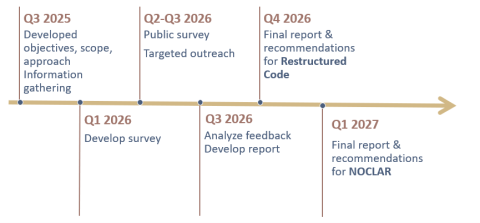
    Timeline and outputs for PIR projects

    Q7. What are the expected outputs and timeline for the project?

    The key expected outputs of the project include:

    • April 1, 2026 – Launch of public surveys (open for 90–120 days).
    • December 2026 – Final Restructured Code PIR report and recommendations to the IESBA.
    • March 2027 – Final NOCLAR PIR report and recommendations to the IESBA.

    Q8. How will the findings of the PIRs be used?

    The results will inform the IESBA’s assessment of whether any further actions are necessary regarding these standards.

    Based on the findings, the IESBA may conclude that no further action is required or take one or more of the following actions:

    • Undertake further information-gathering;
    • Initiate standard-setting; or
    • Develop non-authoritative materials or other initiatives.

    Q9. Where can stakeholders find more information?

    To learn more about these projects, explore their project pages:

    Q10. Who can stakeholders contact?

    For any queries, please reach out to: Kam Leung, IESBA Director, at kamleung@ethicsboard.org.

    About IESBA

    The International Ethics Standards Board for Accountants (IESBA) is an independent global standard-setting board. The IESBA’s mission is to serve the public interest by setting high-quality, international ethics (including independence) standards as a cornerstone to ethical behavior in business and organizations, and to public trust in financial and non-financial information that is fundamental to the proper functioning and sustainability of organizations, financial markets and economies worldwide.

    Along with the International Auditing and Assurance Standards Board (IAASB), the IESBA is part of the International Foundation for Ethics and Audit (IFEA). The Public Interest Oversight Board (PIOB) oversees IESBA and IAASB activities and the public interest responsiveness of the standards.

  • IESBA Launches Surveys for Post-implementation Reviews of NOCLAR Standard and the Restructured Code

    New York, NY English
    • Global stakeholders are invited to share practical experience on whether the NOCLAR® provisions in the IESBA Code, as well as the Restructured Code, work as intended in the public interest.
    • Survey insights will inform IESBA’s assessment of whether any further actions are necessary regarding these standards.
    • The Post-Implementation Reviews reflect a commitment within IESBA’s current 2024–2027 Strategy and Work Plan, as well as calls from stakeholders, to evaluate the realworld effectiveness of major ethics standards.

    The International Ethics Standards Board for Accountants (IESBA) today launched two stakeholder surveys as part of its Post-Implementation Reviews (PIRs) of the provisions of the Code addressing Responding to Non-Compliance with Laws and Regulations (NOCLAR), and the Restructured Code.

    The surveys aim to assess whether the NOCLAR provisions and the Restructured Code are achieving their intended objectives by identifying benefits and implementation challenges, and to inform any actions the IESBA may need to take in response.

    Among other matters, the surveys seek information in the following areas:

    • The approach to jurisdictional adoption of the NOCLAR provisions and/or the 2018 or later edition of the Restructured Code, and related enforcement responsibilities.
    • Benefits to applying the NOCLAR framework and any specific implementation challenges.
    • Whether the Code’s 2018 restructuring has improved the clarity and usability of the Code, thereby leading to more consistent application and more effective enforcement of the Code.

    “Understanding the realworld impact of standards is as important as setting them. These surveys give stakeholders a vital opportunity to share their practical experience regarding the implementation of the standards,” said Gabriela Figueiredo Dias, Chair of the IESBA. “The PIRs will help the IESBA determine whether further action is needed to ensure that the standards are operating as intended, which is key to upholding the public interest.”

    How to Participate in the Surveys

    The surveys are open to all stakeholder groups, including individual professional accountants, firms, professional accountancy organizations, regulators, oversight bodies, standard setters, preparers, those charged with governance, investors, and other users of financial and nonfinancial information.

    Click on the links below to respond to each survey:

    Building a Robust Evidence Base for Future Decisions

    The public surveys are also complemented by targeted outreach to inform the PIRs, as well as supporting desktop research, to ensure a broad and well-rounded evidence base.

    The PIR results will be analyzed to provide feedback to the IESBA, develop any recommended actions, and inform the IESBA’s future strategy and work plan.

    About IESBA

    The International Ethics Standards Board for Accountants (IESBA) is an independent global standard-setting board. The IESBA’s mission is to serve the public interest by setting high-quality, international ethics (including independence) standards as a cornerstone to ethical behavior in business and organizations, and to public trust in financial and non-financial information that is fundamental to the proper functioning and sustainability of organizations, financial markets and economies worldwide.

    Along with the International Auditing and Assurance Standards Board (IAASB), the IESBA is part of the International Foundation for Ethics and Audit (IFEA). The Public Interest Oversight Board (PIOB) oversees IESBA and IAASB activities and the public interest responsiveness of the standards.

    Contact Information:

    Rui Peres Jorge 
    Director, Strategy and Communications 
    International Ethics Standards Board for Accountants (IESBA) 
    ruiperesjorge@ethicsboard.org | Direct: +351 966-301-383

    Zsolt Bobis 
    Lead, Communications 
    International Ethics Standards Board for Accountants (IESBA) 
    zsoltbobis@ethicsboard.org

  • Now Available: IESBA Handbook 2025 Edition

    New York, NY English

    The International Ethics Standards Board for Accountants (IESBA) today released the 2025 Handbook of the International Code of Ethics for Professional Accountants (including International Independence Standards). This handbook incorporates the tax planning pronouncement that became effective for tax planning services and activities beginning after June 30, 2025.

    The back of Volume 1 of the 2025 Handbook contains the IESBA-approved revisions to the Code addressing Using the Work of an External Expert as well as Sustainability Reporting-related Revisions. These revisions will become effective December 2026.

    The new Volume 2 of the IESBA Handbook contains the International Ethics Standards for Sustainability Assurance (including Independence Standards) and Other Revisions to the Code Relating to Sustainability Assurance and the provisions addressing Using the Work of an External Expert. These provisions become effective December 2026, except for certain independence provisions relating to value chain, which become effective July 2028.

    Click here to learn more about the IESBA Code.


    Reproducing and Translating the IESBA Handbook

    To help adoption and implementation of the IESBA standards, stakeholders are invited to submit requests for permission to reproduce or translate the IESBA Handbook via the Online Permissions Requests or Inquiries system on the IFAC website.

    About IESBA

    The International Ethics Standards Board for Accountants (IESBA) is an independent global standard-setting board. The IESBA’s mission is to serve the public interest by setting high-quality, international ethics (including independence) standards as a cornerstone to ethical behavior in business and organizations, and to public trust in financial and non-financial information that is fundamental to the proper functioning and sustainability of organizations, financial markets and economies worldwide.

    Along with the International Auditing and Assurance Standards Board, the IESBA is part of the International Foundation for Ethics and Audit. The Public Interest Oversight Board (PIOB) oversees IESBA and IAASB activities and the public interest responsiveness of the standards. 

    Digital Access and Print Orders Available

  • IESBA Staff Releases Additional Implementation Support Materials for IESSA

    New York, NY English

    The Staff of the International Ethics Standards Board for Accountants (IESBA) has released two implementation support publications to help sustainability assurance practitioners understand and apply the International Ethics Standards for Sustainability Assurance (including International Independence Standards) (IESSA):

    • Key Differences: A comparison document outlining the main differences between the IESSA and the corresponding provisions of the IESBA Code applicable to audits of financial statement.
    • List of PIE Prohibitions: A list of specific prohibitions in the IESSA applicable to sustainability assurance engagements of public interest entities (PIEs).

    The Key Differences Between IESSA and Parts 1 to 4A of the Code provides an overview of how the IESSA compares to the ethics and independence provisions in the IESBA Code that apply to audits of financial statements. It is intended to support firms that already follow the Code in understanding and implementing the IESSA for sustainability assurance engagements. For reference purposes, the publication is accompanied by a marked-up version of the IESSA showing changes from the corresponding sections of the extant Code.

    The List of Prohibitions for PIEs in IESSA summarizes the specific interests, relationships, non-assurance services and other circumstances prohibited under the IESSA when performing sustainability assurance engagements for PIEs. It is intended as a high-level reference to help sustainability assurance practitioners in further understanding the prohibitions in the IESSA.

    Jurisdictional standard setters, regulators and oversight bodies, professional accountancy organizations, educational institutions and other stakeholders may also find the publications useful.

    These new resources are part of a comprehensive implementation support program the IESBA has put in place—a strategic priority aimed at promoting the adoption and consistent and effective implementation of the IESSA, which becomes effective in December 2026. Led by a dedicated Adoption and Implementation Working Group, this effort includes a growing suite of guidance materials, webinars, and other resources to back the rollout of the Global Ethics Sustainability Standards.

    Read the publications on IESBA’s Support and Resources Page
    Visit the IESBA Sustainability Focus Page


    About IESBA

    The International Ethics Standards Board for Accountants (IESBA) is an independent global standard-setting board. The IESBA’s mission is to serve the public interest by setting high-quality, international ethics (including independence) standards as a cornerstone to ethical behavior in business and organizations, and to public trust in financial and non-financial information that is fundamental to the proper functioning and sustainability of organizations, financial markets and economies worldwide.

    Along with the International Auditing and Assurance Standards Board (IAASB), the IESBA is part of the International Foundation for Ethics and Audit (IFEA). The Public Interest Oversight Board (PIOB) oversees IESBA and IAASB activities and the public interest responsiveness of the standards.

  • Summary of Prohibitions in the IESSA™

    Applicable to Sustainability Assurance Engagements of Public Interest Entities

    This publication is intended to be a useful reference to stakeholders, including regulators and audit/assurance oversight bodies, sustainability assurance (SA) practitioners (SAPs) (including audit firms, conformity assessment bodies or other practitioners), the corporate governance community, investors, preparers, and educational bodies or institutions. References to the relevant provisions in the IESSA are provided in footnotes to assist further understanding of the prohibitions.

    IESBA
    English
  • Key Differences Between The IESSA™ and the Provisions of the IESBA Code Applicable to an Audit of Financial Statements

    This publication provides an overview of the key differences between the IESSA and the ethics and independence provisions in the Code applicable to an audit of financial statements. It is intended to facilitate the understanding and implementation of the IESSA by firms that also follow the Code when performing audits of financial statements. Jurisdictional standard setters, regulators and oversight bodies, professional accountancy organizations, educational bodies and other stakeholders may also find the publication helpful.


    IESBA
    English